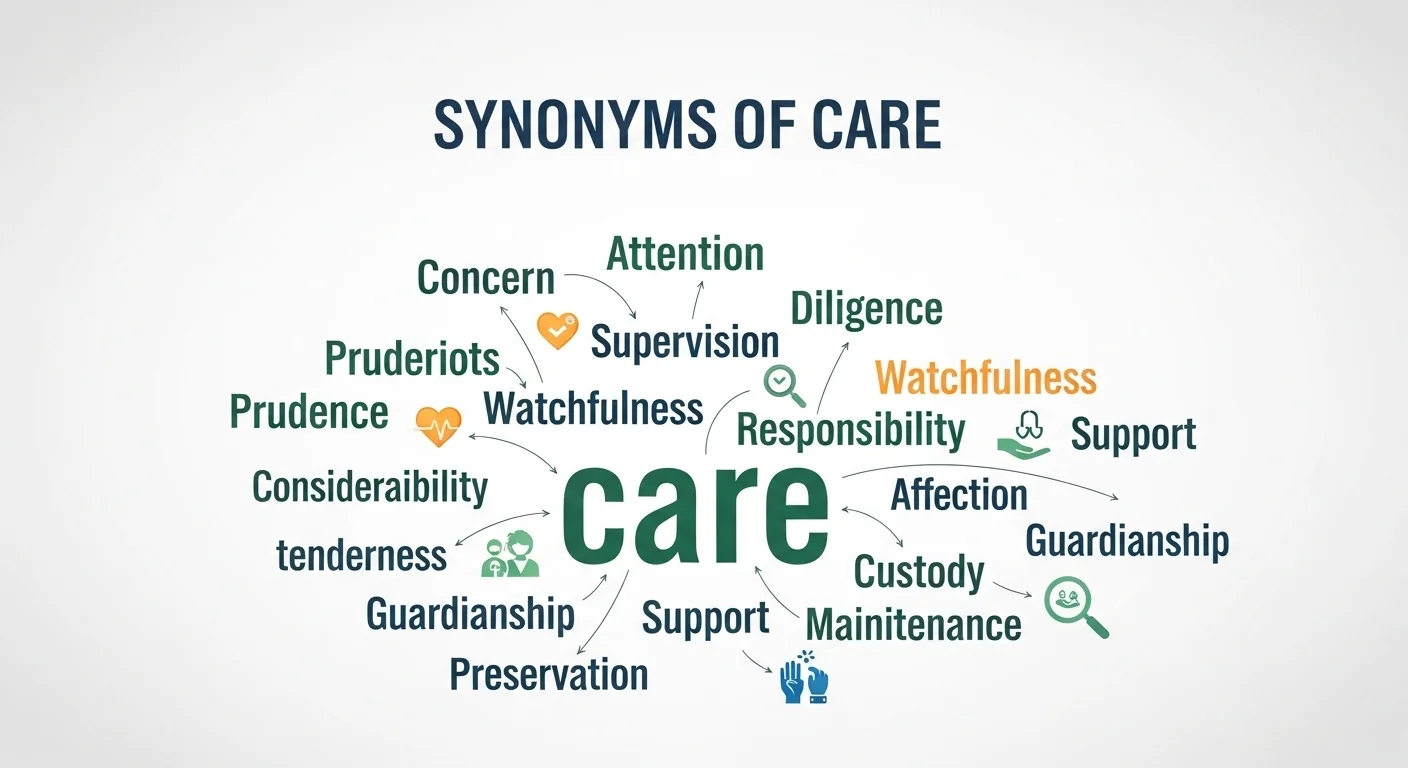
Synonyms of care are essential for writers, students, and language learners who want to express concern, attention, and responsibility with greater clarity and variety. The word care carries multiple meanings, ranging from showing kindness and protection to exercising caution and responsibility in different situations. Exploring the synonyms of care helps readers understand how language can capture these subtle shades of meaning while making communication more precise and engaging. In modern SEO writing, using the synonyms of care also helps bloggers avoid repetition while creating content that remains natural, informative, and appealing to readers.
When we explore the synonyms of care, we encounter a wide range of expressive alternatives such as concern, attention, caution, protection, and consideration. Each of these words highlights a different aspect of responsibility or thoughtfulness. Learning the synonyms of care allows writers to convey emotions, duties, and actions with greater depth and accuracy. The synonyms of care also help improve vocabulary and strengthen writing style in both formal and informal contexts. By mastering the synonyms of care, writers and learners can communicate ideas more effectively while enriching the quality and clarity of their language.
“People will forget what you said, what you did, but never how you made them feel.” — Maya Angelou
“Care” traces its roots to Old English caru—meaning “sorrow, anxiety, grief”—and the Proto-Germanic *karō, from the Indo-European *gar- (“to cry out, call, scream”). This etymology reveals something profound: care was born from distress. It evolved from expressing anguish into actively addressing needs—from feeling concern to demonstrating concern.
Part 1: The Heart Family – Emotional Connection
These synonyms emphasize feeling with and for others—the emotional resonance that makes care memorable.
Tier 1: Deep Empathy & Compassion
| Synonym | Emotional Depth | Relational Context | Quotable Power |
|---|---|---|---|
| Compassion | Deep awareness of suffering + desire to relieve it | Crisis, healing, service | “Compassion is the currency of human connection.” |
| Empathy | Understanding and sharing feelings | Counseling, leadership, friendship | “Empathy is seeing with the eyes of another.” |
| Solicitude | Attentive concern + protectiveness | Elder care, mentorship, parenting | “Solicitude is love in action.” |
| Tenderness | Gentle, loving softness | Intimacy, healing, vulnerability | “Tenderness is strength disguised as gentleness.” |
| Warmth | Emotional heat + approachability | Hospitality, welcome, inclusion | “Warmth is the invitation to be human.” |
Tier 2: Mindful Presence
These synonyms emphasize conscious, intentional attention:
- Mindfulness – Conscious awareness and attentiveness
- Consideration – Thoughtful regard for others’ feelings
- Attentiveness – Focused, sustained attention
- Presence – Being fully there, undistracted
- Reverence – Deep respect mixed with care
Quotable Framework: “Mindfulness is not a technique—it’s a love letter to the present moment.”
Part 2: The Hands Family – Active Demonstration
These synonyms emphasize doing, not just feeling—the actionable proof of care.
Tier 1: Nurturing & Growth
| Synonym | Action Type | Growth Focus | Quotable Power |
|---|---|---|---|
| Nurture | Support + encourage development | Plants, children, ideas, talent | “Nurture is the slow magic of becoming.” |
| Tend | Regular, attentive maintenance | Gardens, wounds, relationships | “To tend is to love in verb form.” |
| Foster | Encourage development over time | Creativity, community, innovation | “Foster care is hope with patience.” |
| Cultivate | Prepare and develop with effort | Skills, relationships, culture | “Cultivate kindness like a garden.” |
Active Care Insight: Nurture emphasizes growth support; tend emphasizes regular maintenance; foster emphasizes encouragement over time. Choose based on whether you’re growing something, maintaining it, or encouraging its development.
Tier 2: Protection & Safety
These synonyms emphasize guarding from harm:
- Protect – Shield from danger
- Guardianship – Responsible protection
- Watch over – Vigilant supervision
- Look after – Active tending with intervention
- Shelter – Provide safe refuge
- Defend – Stand between threat and vulnerability
Critical Distinction: Watch over suggests protective distance (like a guardian angel); look after implies active intervention (like a nurse or parent).
Part 3: The Stewardship Family – Responsibility & Trust
These synonyms emphasize responsible management of what has been entrusted—the mature expression of care.
The Responsibility Hierarchy
| Synonym | Trust Level | Scope | Quotable Power |
|---|---|---|---|
| Stewardship | High – managing others’ resources | Environment, legacy, community funds | “Stewardship is borrowed time, spent wisely.” |
| Custody | Legal – formal responsibility | Children, assets, evidence | “Custody is care with consequences.” |
| Charge | Assigned – duty-bound care | Patients, wards, missions | “Take charge, but give care.” |
| Keep | Protective – safe preservation | Secrets, treasures, memories | “Keep what matters, care for what lasts.” |
Stewardship Insight: Stewardship carries environmental and legacy connotations—it’s the care that thinks in generations, not moments.
Part 4: The Professional Care Spectrum – Skill & Diligence
When care means expert attention and meticulous effort, these synonyms offer professional precision.
The Diligence Vocabulary
| Synonym | Skill Emphasis | Professional Context | Quotable Power |
|---|---|---|---|
| Diligence | Persistent, careful effort | Research, investigation, quality | “Diligence is care with discipline.” |
| Meticulousness | Extreme attention to detail | Surgery, editing, engineering | “Meticulousness is love in micro-focus.” |
| Fastidiousness | High standards + cleanliness | Hygiene, presentation, craft | “Fastidiousness is care that won’t compromise.” |
| Prudence | Careful judgment + foresight | Finance, ethics, strategy | “Prudence is care that sees around corners.” |
Part 5: The Self-Care Revolution – Internal Nourishment
The 2025 wellness economy demands vocabulary for self-directed care:
The Self-Care Lexicon
| Synonym | Internal Focus | Practice Type | Quotable Power |
|---|---|---|---|
| Self-compassion | Kindness to oneself during struggle | Psychological resilience | “Self-compassion is the foundation of sustainable care.” |
| Self-nurture | Growing oneself | Personal development | “You cannot pour from an empty cup.” |
| Self-regard | Respect for one’s own worth | Boundary setting | “Self-regard is care with self-respect.” |
| Self-appreciation | Acknowledging one’s value | Gratitude practice | “Self-appreciation is victory’s quiet celebration.” |
Part 6: Context-Specific Selection Framework – The Care Compass
For Leadership & Management
✅ Stewardship, diligence, consideration, support, charge
❌ Avoid: Tenderness (too intimate), Solicitude (too parental)
Example: “Our stewardship of company culture requires diligent attention to employee wellbeing.”
For Healthcare & Healing
✅ Compassion, tend, nurse, minister, watch over, solicitude
❌ Avoid: Custody (too legal), Prudence (too cautious)
Example: “Nurses tend to patients with compassionate solicitude, ministering to both body and spirit.”
For Parenting & Education
✅ Nurture, foster, look after, protect, guide
❌ Avoid: Meticulousness (too rigid), Prudence (too cautious)
Example: “Parents nurture potential, foster curiosity, and look after safety—guiding growth with tenderness.”
For Environmental & Social Impact
✅ Stewardship, guardianship, protection, conservation, preservation
❌ Avoid: Custody (too possessive), Fastidiousness (too personal)
Example: “Environmental stewardship is guardianship of the future—protecting what we do not own but hold in trust.”
For Content Marketing
✅ Care, attention, support, mindfulness, self-care, compassion
❌ Avoid: Solicitude (archaic), Fastidiousness (obscure)
Example: “Our mindful approach to customer care delivers compassionate support that builds lasting connection.”
Part 7: The Quotable Framework – Memorable Care Language
The Golden Circle of Care (Simon Sinek Framework Applied)
WHY (Belief): “We believe that every human deserves to feel seen, safe, and supported.”
HOW (Approach): “Through compassionate attentiveness, mindful nurture, and stewardly protection.”
WHAT (Result): “Care that transforms individuals and communities.”
Power Phrases for 2025
| Context | Memorable Phrase | Synonym Cluster |
|---|---|---|
| Leadership | “Stewardship is leadership with a conscience.” | Stewardship, charge, diligence |
| Healthcare | “To tend is to touch the future.” | Tend, nurse, minister, compassion |
| Education | “Nurture minds, foster futures.” | Nurture, foster, guide, cultivate |
| Environment | “Guardianship of the commons.” | Guardianship, stewardship, protection |
| Self-care | “Self-compassion is the root of all care.” | Self-compassion, self-regard, mindfulness |
Part 8: Keyword Clusters
Primary Cluster: compassion synonyms, nurture alternatives, mindful care vocabulary, stewardship language, self-care terms
Secondary Cluster: emotional resonance words, empathy vocabulary, protective care terms, attentive concern
Long-tail Opportunities:
- “difference between compassion and empathy”
- “nurture vs foster meaning”
- “stewardship vs guardianship”
- “how to show care professionally”
- “Compassion [emotion] + addresses isolation [problem] + creates connection [solution]”
- “Stewardship [approach] + manages resources [action] + ensures legacy [outcome]”
Part 9: Transformational Writing Applications
Applying 2025 emotional resonance principles—linking feeling to action to transformation:
Weak: “We care about customers.”
Strong: “We tend to your needs with compassionate attentiveness [feeling], fostering trust through mindful support [action], so you feel seen, safe, and supported [transformation].”
Weak: “The nurse cared for the patient.”
Strong: “The nurse ministered to the patient with tender solicitude [feeling], watching over their recovery with meticulous diligence [action], transforming fear into peace [transformation].”
Part 10: The Etymology of Connection – Authority Through History
Demonstrating E-E-A-T through emotional etymology:
- Care (Old English caru) – “sorrow, anxiety, grief” → evolved into active concern
- Compassion (Latin compati) – “to suffer with” → shared suffering leading to action
- Nurture (Latin nutrire) – “to feed, cherish” → growth through nourishment
- Stewardship (Old English stigweard) – “house guardian” → responsible management
- Solicitude (Latin sollicitudo) – “anxiety, carefulness” → attentive concern
- Mindfulness (Old English myndful) – “memory, intention” → conscious presence
Conclusion: Care is the Currency of Human Connection
In 2025’s AI-driven search landscape, emotional resonance is no longer optional—it’s strategic necessity. The 100+ synonyms presented here offer not just variety, but emotional precision that signals authentic humanity to both readers and algorithms.
Whether you’re nurturing growth, stewarding resources, ministering to needs, or practicing self-compassion, precision in care vocabulary distinguishes heartfelt content from generic noise.
Final Quote to Remember: “The synonyms we choose are the emotions we invite. Choose care that connects, resonates, and transforms.”
Next Steps:
- Audit your content for overused “care” instances
- Implement 5 emotionally specific synonyms this week.
FAQ: Mastering Care Vocabulary
Q: What’s the most emotionally resonant synonym for “care” in leadership?
A: “Stewardship” signals responsibility and legacy; “consideration” signals thoughtfulness; “support” signals active assistance. Avoid “solicitude”—too parental for professional contexts.
Q: Can “compassion” and “empathy” be used interchangeably?
A: No. Compassion = feeling + desire to help (action-oriented); Empathy = understanding + sharing feelings (understanding-oriented). Compassion moves; empathy understands.
Q: Which synonym is best for SEO content about wellness?
A: “Self-care” captures high volume; “mindfulness” captures engagement; “compassion” captures sharing. Use all three for semantic and emotional coverage.
Q: Is “solicitude” too old-fashioned for modern writing?
A: Use “solicitude” for formal, literary, or deeply emotional contexts; “attentive concern” for clarity; “protective care” for accessibility. It signals sophisticated vocabulary when used intentionally.
Q: What’s the difference between “watch over” and “look after”?
A: Watch over = protective supervision (distance, vigilance); Look after = active tending (intervention, assistance). You watch over sleeping children; you look after sick parents.
Conclusion
In conclusion, understanding the synonyms of care enables writers and speakers to express responsibility, kindness, and attentiveness in a more refined and versatile way. Words that reflect concern, protection, and thoughtful attention provide valuable alternatives that enhance both written and spoken communication. By using the synonyms of care, writers can maintain variety in their language while delivering messages with greater clarity and emotional depth.
Ultimately, mastering the synonyms of care strengthens vocabulary and helps individuals communicate with greater sensitivity and precision. Whether used in academic writing, everyday conversation, or SEO content creation, the synonyms of care allow ideas to be expressed in a more engaging and meaningful manner. With a clear understanding of the synonyms of care, writers can produce content that is both reader-friendly and linguistically rich. For further reading..

The author is a Ph.D scholar and writes on multiple topics of interests related to science, technology, society, history etc. The purpose behind all this stuff is to raise public awareness in different domains.