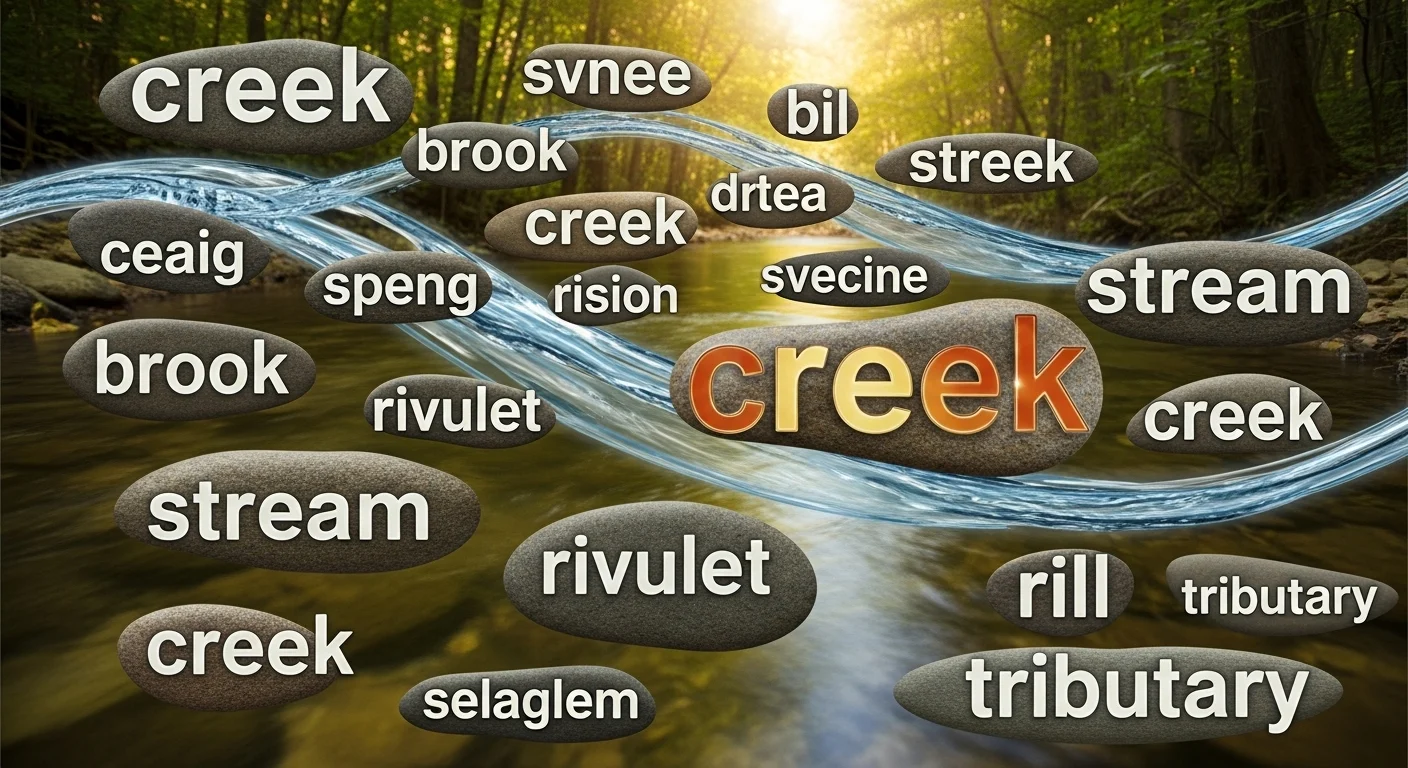
Synonyms of creek bring color and clarity to even the simplest nature story. Last summer, a child skipped stones across a quiet creek behind his house. The water was shallow. It moved slowly. Tiny fish flashed like silver threads in the sun. That small stream made the place feel alive.
A creek is a small, narrow body of flowing water. It is smaller than a river. People use this word in daily life, in stories, and in geography. It is common in American English.
Learning synonyms of creek helps students, bloggers, writers, and teachers avoid repeating the same word again and again. When you explore synonyms of creek, you discover words like brook, stream, rivulet, and tributary. Using different synonyms of creek makes your sentences more vivid and precise. Strong vocabulary grows when you practice synonyms of creek in speaking and writing. Vocabulary is like a toolbox. The more tools you have, the better your work becomes.
Meaning of Creek
Definition
Creek (noun):
A small, narrow stream of water that flows naturally.
Examples
The children played near the creek after school.
The creek dries up during hot summer days.
Connotative Meaning
(Connotation means the emotional feeling or idea a word suggests beyond its basic meaning.)
Positive tone: calm, peaceful, natural beauty
Negative tone: muddy, flooded, dangerous
Neutral tone: simply a small stream of water
Etymology
The word creek comes from Old Norse kriki, meaning a corner or bend.
Short History
Old English (450–1100): The word was not common in this period. Other words for streams were used.
Middle English (1100–1500): The word began to appear, often meaning a small inlet or bend of water.
Modern English (1500–Present): In American English, creek became widely used to mean a small stream.
Pronunciation (US & UK – IPA)
US: /kriːk/
UK: /kriːk/
Syllables
creek
Affixation Pattern of Creek
Root: creek
Prefix: none
Suffix: none
Synonyms of Creek
1. Stream (noun) — US /striːm/ | UK /striːm/
Meaning: A small flow of water moving in one direction.
Examples:
A clear stream runs through the valley.
They crossed the stream using stones.
2. Brook (noun) — US /brʊk/ | UK /brʊk/
Meaning: A small natural stream.
Examples:
A quiet brook flows behind the farm.
We heard the brook at night.
3. Rivulet (noun) — US /ˈrɪvjəˌlɛt/ | UK /ˈrɪvjʊlɛt/
Meaning: A very small stream.
Examples:
A rivulet formed after the rain.
Water ran in a thin rivulet.
4. Tributary (noun) — US /ˈtrɪbjəˌtɛri/ | UK /ˈtrɪbjʊtəri/
Meaning: A stream that flows into a larger river.
Examples:
The creek is a tributary of the main river.
Many small tributaries join here.
5. Watercourse (noun) — US /ˈwɔtərˌkɔrs/ | UK /ˈwɔːtəˌkɔːs/
Meaning: A natural channel where water flows.
Examples:
The watercourse floods in spring.
Farmers built near the watercourse.
6. Channel (noun) — US /ˈtʃænəl/ | UK /ˈtʃænəl/
Meaning: A narrow path for water.
Examples:
The creek cut a deep channel.
Boats moved along the channel.
7. Run (noun) — US /rʌn/ | UK /rʌn/
Meaning: A small stream of flowing water.
Examples:
A run flows past the cabin.
The run dries in summer.
8. Inlet (noun) — US /ˈɪnlɛt/ | UK /ˈɪnlɛt/
Meaning: A small arm of water that goes into land.
Examples:
The boat entered the inlet.
The inlet was calm at sunset.
9. Beck (noun) — US /bɛk/ | UK /bɛk/
Meaning: A small stream (used in northern England).
Examples:
She walked beside the beck.
The beck runs through the hills.
10. Burn (noun) — US /bɜrn/ | UK /bɜːn/
Meaning: A small stream in Scotland.
Examples:
The burn flows quickly after rain.
Children played near the burn.
11. Arroyo (noun) — US /əˈrɔɪoʊ/ | UK /əˈrɔɪəʊ/
Meaning: A dry creek bed that fills with water after rain.
Examples:
The arroyo flooded suddenly.
They crossed the dry arroyo.
12. Branch (noun) — US /bræntʃ/ | UK /brɑːntʃ/
Meaning: A small stream flowing into a larger one.
Examples:
The branch joins the river nearby.
A narrow branch runs here.
13. Rill (noun) — US /rɪl/ | UK /rɪl/
Meaning: A tiny stream.
Examples:
A rill flowed through the garden.
Rain formed a small rill.
14. Gully (noun) — US /ˈɡʌli/ | UK /ˈɡʌli/
Meaning: A small valley with water flow.
Examples:
Water rushed through the gully.
The gully filled with rainwater.
15. Torrent (noun) — US /ˈtɔrənt/ | UK /ˈtɒrənt/
Meaning: A fast and strong stream.
Examples:
The creek became a torrent.
Rain turned it into a torrent.
16. Estuary (noun) — US /ˈɛstʃuˌɛri/ | UK /ˈɛstjuəri/
Meaning: The wide mouth of a river meeting the sea.
Examples:
Fish live in the estuary.
The estuary is rich in life.
17. Bayou (noun) — US /ˈbaɪuː/ | UK /ˈbaɪuː/
Meaning: A slow-moving stream in the southern US.
Examples:
The bayou is calm and deep.
Alligators live in the bayou.
18. Fjord (noun) — US /fjɔrd/ | UK /fjɔːd/
Meaning: A long, narrow sea inlet between cliffs.
Examples:
The fjord is deep and cold.
Ships travel through the fjord.
19. Canal (noun) — US /kəˈnæl/ | UK /kəˈnæl/
Meaning: A man-made water channel.
Examples:
The canal runs beside the road.
Boats use the canal daily.
20. Ditch (noun) — US /dɪtʃ/ | UK /dɪtʃ/
Meaning: A narrow channel dug for water.
Examples:
Water filled the ditch.
The ditch drains the field.
21. Spillway (noun) — US /ˈspɪlˌweɪ/ | UK /ˈspɪlweɪ/
Meaning: A channel for excess water.
Examples:
Water rushed through the spillway.
The dam opened the spillway.
22. Culvert (noun) — US /ˈkʌlvərt/ | UK /ˈkʌlvət/
Meaning: A tunnel carrying water under a road.
Examples:
The creek passed through a culvert.
Leaves blocked the culvert.
23. Drain (noun) — US /dreɪn/ | UK /dreɪn/
Meaning: A channel for carrying off water.
Examples:
Rain flowed into the drain.
The drain leads to the creek.
24. Runoff (noun) — US /ˈrʌnˌɔf/ | UK /ˈrʌnɒf/
Meaning: Water that flows over land into streams.
Examples:
Runoff filled the creek.
Heavy rain caused runoff.
25. Waterway (noun) — US /ˈwɔtərˌweɪ/ | UK /ˈwɔːtəweɪ/
Meaning: A route for water or boats.
Examples:
The waterway connects towns.
The creek is a small waterway.
26. Spring (noun) — US /sprɪŋ/ | UK /sprɪŋ/
Meaning: A place where water comes from the ground.
Examples:
The spring feeds the creek.
Clear water rises from the spring.
27. Headwater (noun) — US /ˈhɛdˌwɔtər/ | UK /ˈhɛdˌwɔːtə/
Meaning: The source of a stream.
Examples:
The headwater begins in the hills.
Snow melts at the headwater.
28. Wash (noun) — US /wɑʃ/ | UK /wɒʃ/
Meaning: A dry stream bed in desert areas.
Examples:
The wash flooded quickly.
They drove across the dry wash.
29. Lagoon (noun) — US /ləˈɡuːn/ | UK /ləˈɡuːn/
Meaning: A shallow body of water near the sea.
Examples:
The lagoon is warm and calm.
Fish swim in the lagoon.
30. Streamlet (noun) — US /ˈstriːmlɪt/ | UK /ˈstriːmlɪt/
Meaning: A very small stream.
Examples:
A streamlet crossed the path.
The streamlet sparkled in sunlight.
Prototype Meaning
When people hear the word creek, they often imagine a small, shallow stream in the countryside. The water is clear or slightly muddy. It moves gently over stones. Trees grow along its banks. It feels peaceful and natural.
Read more about Prototype Meaning….
Prototype Categorization
Very small natural streams: brook, rivulet, rill, streamlet
Regional words: beck, burn, bayou, arroyo
Man-made channels: canal, ditch, culvert, drain
Large or strong flows: torrent, estuary, fjord
Categorization helps writers choose the best word. If you write about Scotland, burn fits better than brook. If you describe strong water, torrent works better than creek.
Short Questions and Answers
- What does creek mean?
A small natural stream of flowing water. - When should creek be used?
Use it when talking about a small stream, especially in American English. - Is creek positive or negative?
It is usually neutral, but it can feel peaceful or dangerous depending on context. - How is it different from similar words?
A creek is smaller than a river. Words like brook or rivulet may mean even smaller streams.
CONCLUSION
Learning the word creek and its synonyms improves your vocabulary step by step. You avoid repeating the same word. Your writing becomes clear and lively. You can describe nature with more detail. When speaking, you sound more confident and natural.
Each new synonym is like adding a new color to your language palette. With practice, your English grows stronger. Try learning a few new words every day. Use them in sentences. Soon, your vocabulary will flow as smoothly as a quiet creek.

The author is a Ph.D scholar and writes on multiple topics of interests related to science, technology, society, history etc. The purpose behind all this stuff is to raise public awareness in different domains.








6 thoughts on “Synonyms of Creek —Powerful Alternatives to Improve Vocabulary”