Table of Contents
- Part One: Understanding the Foundation of Great Prompts
- What Makes a ChatGPT Prompt Effective
- Why Step-by-Step Prompting Beats Random Guessing
- How ChatGPT Actually Processes Your Words
- The Four Pillars of Every Powerful Prompt
- Common Myths About Prompt Writing That Hold You Back
- Part Two: The Step-by-Step Prompt Writing System
- Step One: Define Your Goal with Crystal Clarity
- Step Two: Choose the Right Persona for the Job
- Step Three: Build Context That Guides the AI
- Step Four: Specify Format and Structure
- Step Five: Add Constraints That Sharpen Focus
- Step Six: Iterate and Refine Until Perfect
- Part Three: Advanced Techniques and Real-World Mastery
- Chain Prompting for Complex Projects
- Role-Playing Prompts That Transform Output Quality
- Format-Specific Prompts for Professional Results
- Prompt Templates You Can Use Today
- Building Your Personal Prompt Library
- The Future of Step-by-Step Prompt Engineering
Part One: Understanding the Foundation of Great Prompts
What Makes a ChatGPT Prompt Effective
An effective ChatGPT prompt delivers exactly what you need on the first try. It eliminates guesswork and it saves time, produces output so good that you barely need to edit. But what separates an effective prompt from a weak one?
The answer lies in specificity. A weak prompt asks the AI to guess your intentions. An effective prompt leaves no room for guessing. It tells the AI who you are, what you want, why you want it, and how you want it delivered. Every word serves a purpose. Every detail guides the model toward your desired outcome.
Think of prompt writing like giving directions to a driver. You would never say “Drive somewhere nice.” You would say “Drive to the downtown library on Main Street. Take the highway exit at mile marker twelve. Turn left at the second light. Park in the underground garage. I need to arrive by two o’clock.” Effective ChatGPT prompts work the same way. They give the AI a complete roadmap.

Research from MIT confirms that the way you frame prompts shapes the AI’s output directly. Providing context, being specific, and building on the conversation produces vastly better results than simple one-line questions. The art of refining prompts, called prompt engineering, involves selecting the right words, phrases, symbols, and formats to get the best possible result from AI models.
Google’s own prompt engineering documentation reveals that massive AI prompts are off-putting and unnecessary. Instead, an effective prompt needs just four essential parts: persona, task, context, and format. Master these four parts and your prompts will consistently outperform those of casual users.
Why Step-by-Step Prompting Beats Random Guessing
Many beginners approach ChatGPT like a slot machine. They type random phrases, hope for jackpot results, and feel frustrated when the output misses the mark. This random approach wastes time and produces inconsistent quality.
Step-by-step prompting replaces luck with strategy. It treats prompt writing as a craft with clear stages. Each stage builds on the last. Each stage adds precision. By the time you reach the final step, the AI has everything it needs to generate outstanding results.
The step-by-step approach also makes prompt writing teachable. You can learn it. Similarly, you can practice it an you can improve it. Random guessing offers no such path. You cannot get better at guessing. You can get much better at following a proven system.
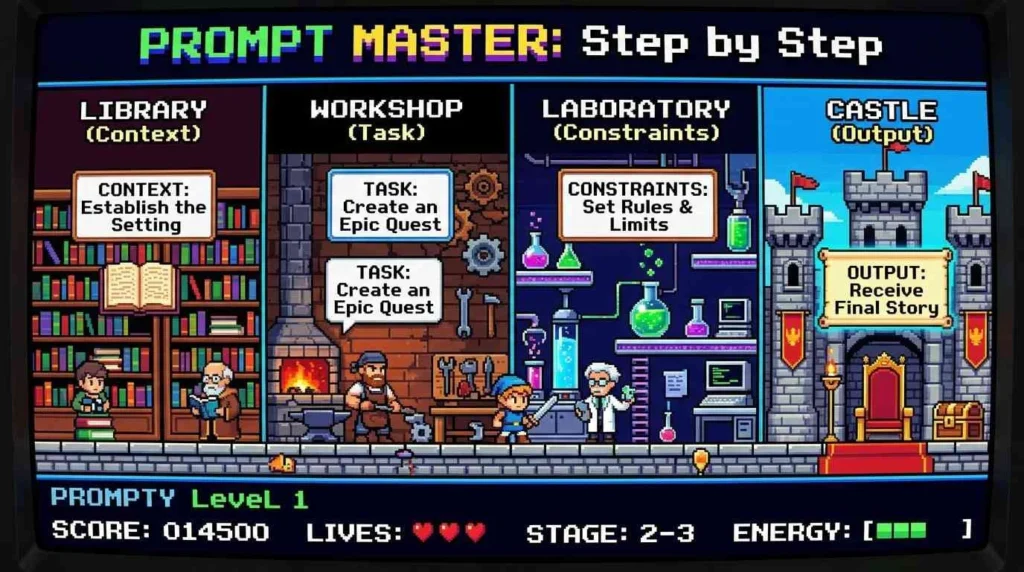
Atlassian’s research on AI prompting shows that structured prompts with clear task instructions, context, and format specifications generate more targeted and relevant responses. Open-ended prompts usually result in more open-ended results, which means you have less control over your output. The more details you provide through a step-by-step structure, the more customized your response becomes.
Step-by-step prompting also helps you debug failures. When a prompt produces poor output, you can identify which step went wrong. Maybe your goal was unclear and maybe your context was thin. And it maybe your format was vague. Each step offers a checkpoint for improvement. Random guessing offers no such diagnostics. More ChatGPT related content here.
How ChatGPT Actually Processes Your Words
To write effective ChatGPT prompts step by step, you need to understand what happens under the hood. This knowledge transforms you from a hopeful typer into a strategic engineer.
ChatGPT runs on a transformer architecture, a type of neural network trained on vast amounts of text from books, websites, articles, and conversations. When you type a prompt, the AI breaks your text into tokens, which are small pieces of words or whole words. It then analyzes the relationships between these tokens using attention mechanisms. These mechanisms help the AI figure out which words in your prompt matter most and how they connect to each other.
For example, if you write “Write a funny story about a cat who thinks he is a dog,” the AI pays attention to several key elements. It notices “funny” and adjusts its tone toward humor.
May it sees “story” and switches into narrative mode. It spots “cat” and “dog” and pulls from its training data about pet behaviors and identity confusion tropes. It processes all these signals simultaneously to generate a response that matches your request.
Learn More
The AI does not remember your previous conversation unless you tell it to. Each prompt exists within a context window, which is like a short-term memory limit. As of 2026, ChatGPT’s context window can handle thousands of words, but it still has limits. This means you should include relevant background information directly in your prompt rather than assuming the AI remembers what you said ten messages ago.
ChatGPT also does not have real-time internet access in most versions. It knows information up to its training cutoff date. It cannot browse the web, check current news, or access your personal files unless specifically connected to tools that allow this. Your prompt must work within these constraints.
Understanding these mechanics helps you write effective ChatGPT prompts that align with how the AI actually functions. You stop expecting mind-reading and start engineering results.
The Four Pillars of Every Powerful Prompt
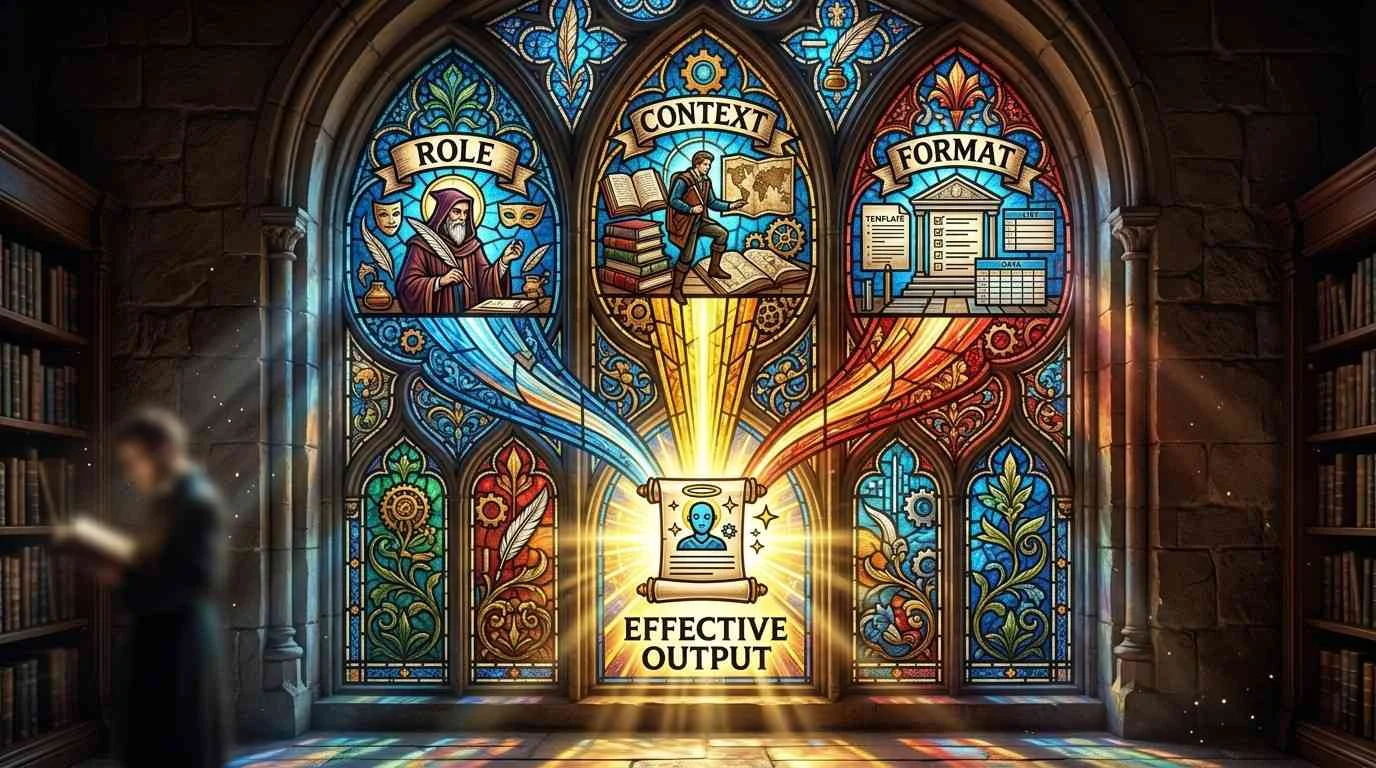
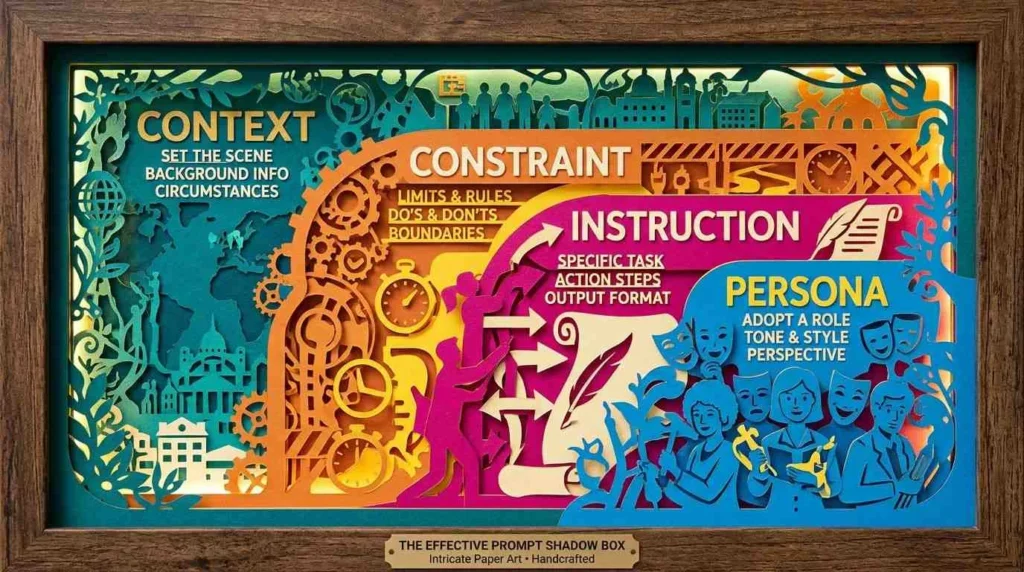
Every effective ChatGPT prompt rests on four pillars. Master these pillars and your prompts will consistently produce better results.
Pillar One: Persona
Tell the AI who it should be. This sets the tone and expertise level. Instead of “Explain quantum physics,” try “You are a patient physics professor who specializes in making complex topics accessible to high school students. Explain quantum physics.” The persona activates specific knowledge patterns and adjusts vocabulary accordingly.
Pillar Two: Task
Specify exactly what you want, with clear parameters. Vague tasks produce vague outputs. Instead of “Help me with my essay,” try “Write an outline for a 1,500-word persuasive essay arguing that remote work improves employee productivity. Include three main points with two supporting evidence examples for each.”
Pillar Three: Context
Share your goals and any relevant examples. Context shapes relevance. Instead of “Give me marketing ideas,” try “I run a small bakery in Portland, Oregon, specializing in gluten-free pastries. My target customers are health-conscious millennials. Give me five low-cost marketing ideas for Instagram.”
Pillar Four: Format
Define how you want the output structured. Format controls readability. Instead of “Tell me about dinosaurs,” try “List five fascinating dinosaur species in bullet points. For each, include its size, diet, one unique feature, and the era it lived in.”
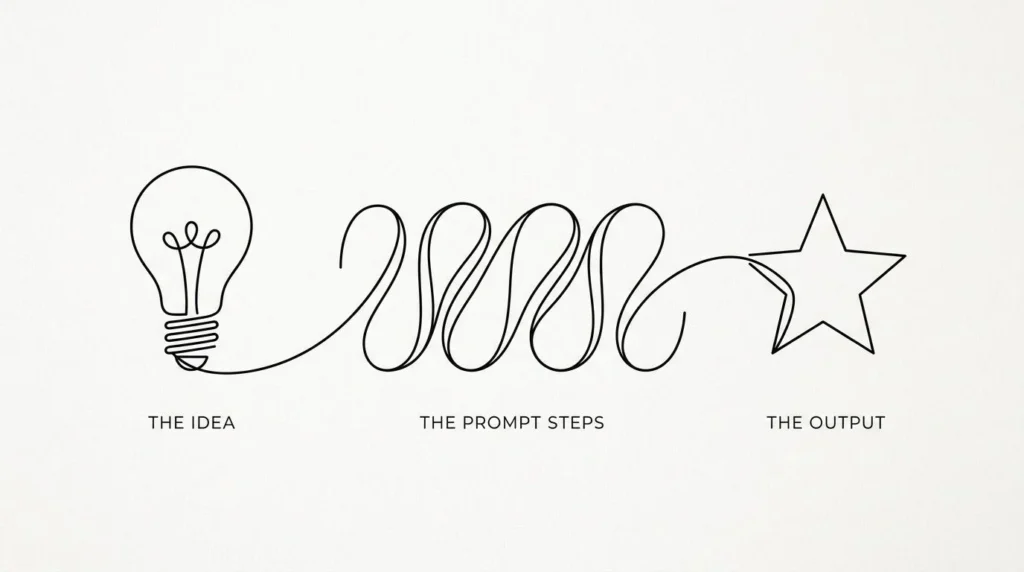
These four pillars form the backbone of every effective ChatGPT prompt. Beginners often include only one or two. Experts layer all four together like a recipe. As you practice, building these pillars into your prompts becomes automatic.
Common Myths About Prompt Writing That Hold You Back
Before diving into the step-by-step system, let us clear away five myths that block beginners from success.
Myth One: Longer Prompts Always Work Better
Massive prompts with endless paragraphs of instructions are off-putting to read and often confuse the AI. Google’s prompt engineers recommend concise, structured prompts over lengthy ones. Quality beats quantity every time.
Myth Two: You Need to Be a Programmer to Write Good Prompts
Prompt engineering requires no coding knowledge. It requires clear thinking and good communication. If you can explain what you want to a human, you can learn to explain it to an AI.
Myth Three: The First Output Should Be Perfect
The first response rarely satisfies completely. Treat prompting as a conversation. Ask for revisions. Refine your instructions. Iteration is a feature, not a failure.
Myth Four: ChatGPT Can Read Your Mind
The AI has no access to your thoughts, your files, or your history unless you provide them. Never assume context. Always include relevant background directly in your prompt.
Myth Five: There Is One Perfect Prompt for Every Task
The best prompt for a task depends on your audience, your goals, and your constraints. Effective prompt writers adapt their approach. They do not copy and paste rigid templates.
Clearing these myths frees you to learn the step-by-step system with an open mind. You stop chasing shortcuts and start building real skill.
Part Two: The Step-by-Step Prompt Writing System
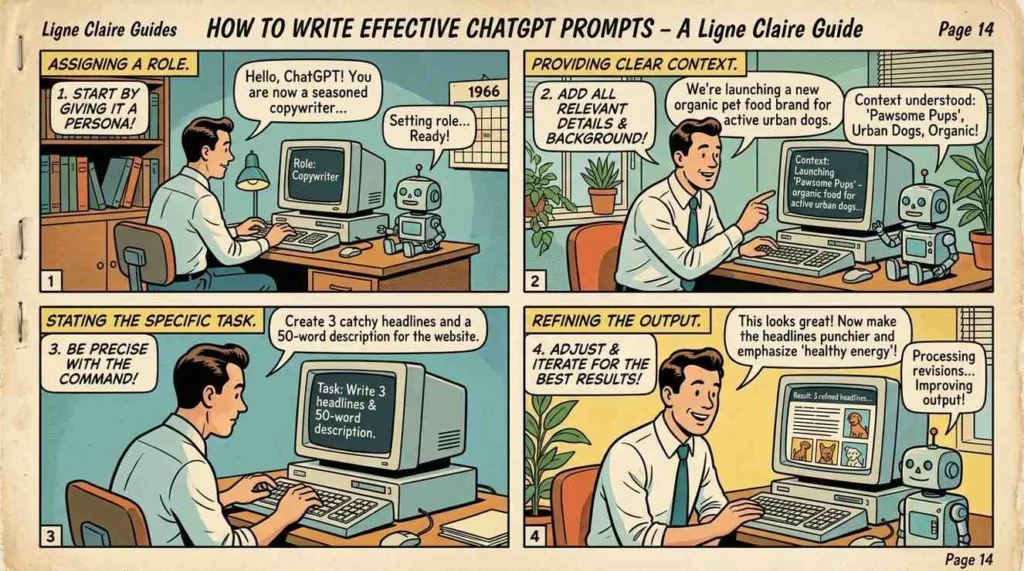
Step One: Define Your Goal with Crystal Clarity
Every great prompt begins with a clear goal. Vague goals produce vague results. Crystal-clear goals produce crystal-clear results.
Start by asking yourself three questions. What do I want the AI to produce? Who will read this output? What will they do with it?
If you want a blog post, specify the topic, length, tone, and target audience. If you want code, specify the language, functionality, and error-handling requirements and if you want a story, specify the genre, length, characters, and mood.
Compare these two prompts. “Write something about dogs” versus “Write a 300-word guide for first-time Golden Retriever owners covering grooming, exercise, and common health issues.” The first prompt could produce anything from a haiku to a research paper. The second prompt gives the AI a precise target.
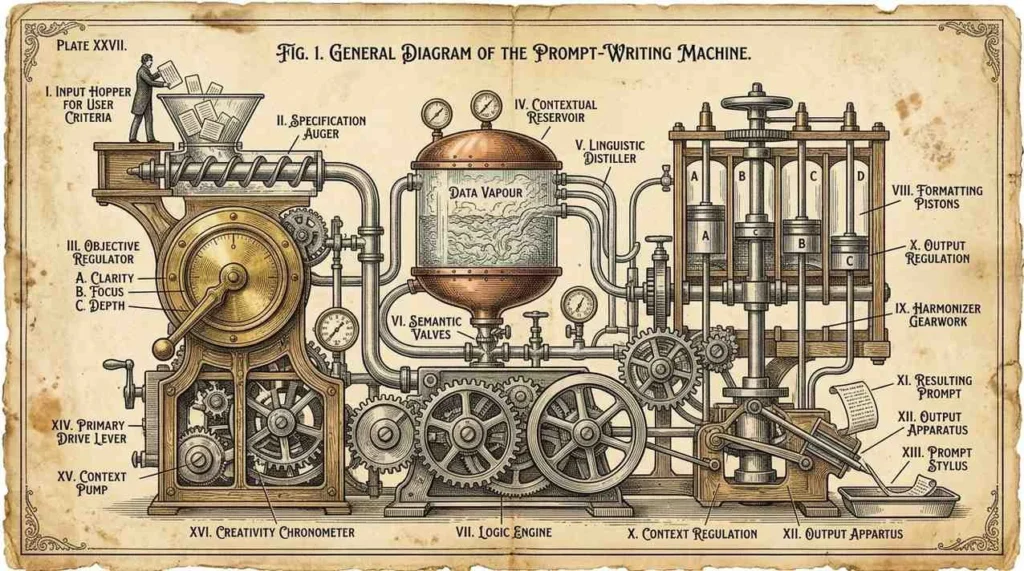
MIT’s guide to effective prompts emphasizes that being specific and providing more details helps you understand your prompt better and generates a more customized response with fewer errors. The granularity of your input is directly proportional to the utility of the output you receive.
Write your goal down before you touch the keyboard. State it in one sentence. Make it so specific that a stranger could execute it without asking questions. This sentence becomes the foundation of your entire prompt.
Step Two: Choose the Right Persona for the Job
Persona is the most underused pillar in prompt writing. When you assign a role to ChatGPT, you activate a specific subset of its training data. The AI adjusts its vocabulary, tone, and reasoning patterns to match the persona you specify.
A doctor uses medical terminology. A chef uses sensory language. A lawyer uses structured arguments. A kindergarten teacher uses simple words and warm encouragement. Each persona unlocks different capabilities within the same model.
Google’s four-part prompt formula starts with persona for good reason. Telling the AI who it should be sets the tone and expertise level for everything that follows.
Here are examples of effective persona selection.
“You are a seasoned sushi chef teaching a beginner how to make their first roll. Use encouraging language. Explain each step as if demonstrating in person.”
“You are a strict but fair editor reviewing a manuscript. Mark every grammar error. Flag every cliché. Suggest one concrete improvement per page.”
“You are a patient career counselor helping a mid-level professional switch industries. Ask probing questions. Offer realistic timelines. Avoid toxic positivity.”
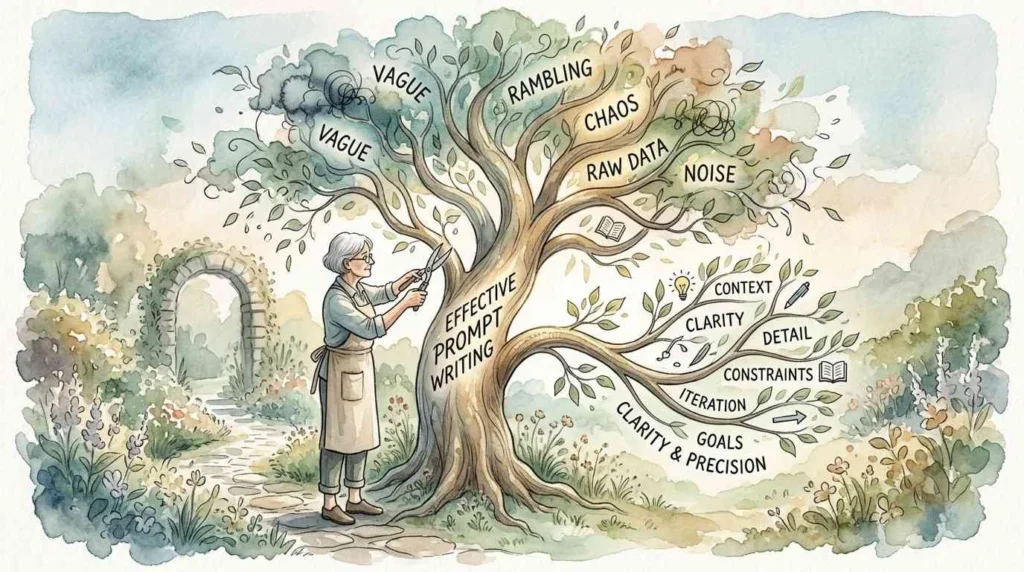

Each persona establishes expertise, perspective, and emotional register. The AI cannot actually think like a chef or an editor. But it can generate text that mimics the patterns of those roles with surprising accuracy.
Tips for better persona selection include specifying experience level, defining the audience the role addresses, adding emotional or stylistic modifiers, and combining multiple roles for complex tasks. A “data scientist and storyteller” produces different output than either role alone.
Step Three: Build Context That Guides the AI
Context tells the AI why your task matters and what background it needs to succeed. Without context, the AI guesses. With context, the AI knows.
Context includes your goals, your constraints, your audience, your examples, and your relevant history. The more context you provide, the more targeted the output becomes.
Atlassian’s research shows that context is the best way to get targeted results from your AI prompts. Whether you are using AI for content creation, automation, or refining your writing, providing context tells the AI how you want it to perform a task.
Here is an example of context building in action.
Weak prompt: “Write an email to a client.”
Strong prompt: “I am an account manager at a SaaS company. Write an email to our enterprise client, Acme Corp, requesting feedback on the recent project delivery. Include a brief summary of the project highlights, thank them for their collaboration, and ask specific questions about their satisfaction with the deliverables and any areas for improvement. The client values brevity and data-driven communication.”
The strong prompt includes who you are, who the recipient is, what the relationship looks like, what the email should contain, and what tone fits the audience. The AI now has everything it needs to write an effective email.
When building context, include specific details like names, dates, locations, and numbers. Share examples of what you like and dislike. Describe your audience’s knowledge level, preferences, and pain points. The AI uses all of this to calibrate its response.
Step Four: Specify Format and Structure
Format controls how information reaches your brain. A wall of text overwhelms. Bullet points scan easily. Tables compare quickly. Code blocks display cleanly. ChatGPT can output in almost any format you specify. You just need to ask.
Atlassian’s guide emphasizes that different formats work for different types of content. Emails should be short and sweet, but blog posts can be thousands of words long. When writing an AI prompt, tell the AI what format you want the response to be in.
Here are format options to consider.
Bullet points and lists work for scannable information. “List the top ten time management techniques for remote workers. Format as numbered bullet points with a one-sentence description for each.”
Tables work for comparisons and structured data. “Compare Python, JavaScript, and Ruby across these dimensions: learning curve, popular use cases, average salary, and community size. Present as a markdown table.”
Code blocks work for programming and technical content. “Write a CSS snippet that centers a div both horizontally and vertically. Include comments explaining each line. Format as a code block.”
Dive Deep For More Below
Markdown headings work for long-form content with clear structure. “Write a 1,000-word guide on composting for beginners. Use H2 headings for main sections and H3 headings for subsections. Include a summary checklist at the end.”
JSON or XML work for structured data extraction. “Extract the following information from this text and format as JSON: author name, publication date, main topic, three key points, and one actionable takeaway.”
Scripts and dialogues work for creative and educational content. “Write a five-minute podcast script about the history of coffee. Include host introduction, two segments with transitions, and a call to action for listeners to subscribe.”
Step-by-step instructions work for procedural content. “Explain how to bake sourdough bread. Break into numbered steps. Include ingredients list, timing for each step, and one troubleshooting tip for common mistakes.”
Specifying format in your ChatGPT prompts serves two purposes. First, it improves readability for you. Second, it forces the AI to organize its thoughts, which often produces more coherent and complete responses.
Step Five: Add Constraints That Sharpen Focus
Constraints are the secret weapon of expert prompt writers. They force the AI to work within boundaries, which paradoxically unlocks more creativity and precision.
Constraints can include word counts, forbidden words, required elements, tone restrictions, and logical rules. Each constraint narrows the AI’s focus and improves output quality.
Here are examples of effective constraints.
“Write a 200-word mystery story set in a lighthouse. Do not use the words ‘dark,’ ‘storm,’ or ‘ghost.’ End with a surprise twist.”
“Explain blockchain technology in under 150 words. Use analogies involving everyday objects. Avoid technical jargon. Assume the reader has no prior knowledge.”
“Create a marketing slogan for a coffee shop. Maximum ten words. Must include the word ‘morning.’ Must rhyme. Must appeal to commuters aged 25 to 40.”
“Write a Python function that sorts a list of names alphabetically. Do not use built-in sort methods. Include error handling for empty lists. Add comments explaining each line.”
Constraints transform generic output into tailored masterpieces. They show the AI exactly where the boundaries lie. Without constraints, the AI drifts. With constraints, the AI delivers.
When adding constraints, be specific but reasonable. Asking for a ten-thousand-word essay in fifty words is impossible. Asking for a complex analysis without any technical terms may dilute accuracy. Balance creativity with feasibility.
Step Six: Iterate and Refine Until Perfect
Your first prompt rarely delivers perfection. Expert prompt engineers treat the process as a conversation, not a one-shot deal. They iterate and they refine. They improve.
MIT’s guide to effective prompts emphasizes building on the conversation. If you do not get the results you want from AI tools, tell the AI how to improve those results until you get what you want.
Here is how iteration works in practice.
First draft prompt: “Write a blog post about meditation.”
First output: Generic, shallow, uninspired.
Second iteration: “Write a 1,000-word blog post about meditation for beginners. Focus on five practical techniques. Use a warm, encouraging tone. Include one personal anecdote. Format with H2 headings and bullet points.”
Second output: Better structure, better tone, still lacks depth.
Third iteration: “Expand the section on breathing techniques. Add scientific backing from peer-reviewed studies. Include a simple exercise readers can try in five minutes. Maintain the warm, encouraging tone.”
Third output: Deep, practical, scientifically grounded, perfectly toned.
Each iteration adds specificity. Each iteration corrects a weakness from the previous round. Over three to five iterations, output quality improves dramatically.
Tips for effective iteration include saving successful prompt patterns, noting which phrasings produce better results, and treating the AI as a collaborative partner rather than a magic oracle. The conversation format exists for a reason. Use it.
Part Three: Advanced Techniques and Real-World Mastery
Chain Prompting for Complex Projects
Complex projects overwhelm single prompts. Chain prompting breaks large tasks into smaller, sequential steps. Each step feeds into the next. The AI builds complexity layer by layer.
Here is how chain prompting works for writing a white paper.
Prompt one: “Outline a ten-section white paper on the future of renewable energy. Include section titles, key points per section, and one source to research per section.”
Prompt two: “Write section one based on the outline. Focus on solar energy advances. Use academic tone. Include two statistics. Cite sources.”
Prompt three: “Write section two based on the outline. Focus on wind energy innovations. Connect to section one’s themes. Maintain academic tone.”
Prompt four: “Write an executive summary that synthesizes all sections. Highlight three key takeaways for policymakers.”
Each prompt in the chain references previous output. The AI maintains coherence across the entire document. Without chaining, a single prompt would struggle to maintain quality across ten sections.
Chain prompting also helps you debug. If section five goes wrong, you fix the prompt for section five without rewriting the entire project. This modularity saves time and preserves quality.
Role-Playing Prompts That Transform Output Quality
Role-playing prompts rank among the most powerful tools in prompt writing. When you assign a detailed role to ChatGPT, you activate a specific subset of its training data. The AI adjusts its vocabulary, tone, and reasoning patterns to match the persona you specify.
Here are advanced role-playing examples.
“You are a skeptical venture capitalist reviewing a startup pitch. Identify three weaknesses in this business plan and suggest concrete improvements. Be direct but constructive. Use bullet points for clarity.”
“You are a Renaissance art historian analyzing this painting description through the lens of 16th-century Italian artistic movements. Reference specific artists and techniques. Avoid modern interpretations.”
“You are a certified financial planner with fifteen years of experience. A 28-year-old software engineer earning $95,000 annually asks for investment advice. They have no debt, a six-month emergency fund, and want to retire by 55. Create a step-by-step investment strategy. Format your response as: 1) Immediate actions this month, 2) Year-one portfolio allocation with percentages, 3) Risk management principles, 4) One common mistake to avoid.”
Each role-playing prompt establishes expertise, perspective, and constraints. The AI generates text that mimics the patterns of those roles with surprising accuracy.
Tips for better role-playing include being specific about the role’s experience level, defining the audience the role addresses, adding emotional or stylistic modifiers, and combining multiple roles for complex tasks.
Format-Specific Prompts for Professional Results
Professionals need professional output. Format-specific prompts ensure the AI delivers content ready for immediate use.
For Email Marketing
“Write a welcome email sequence of three emails for new subscribers to a fitness app. Email one: introduction and app tour.
In Email two: first workout recommendation. Email three: community invitation. Each email must be under 150 words. Use energetic, inclusive tone. Include one call to action per email.”
For Social Media
“Create a week’s worth of LinkedIn posts for a B2B SaaS founder. Five posts total. Mix formats: one personal story, one industry insight, one data visualization description, one question for engagement, one behind-the-scenes team moment. Each post must be under 125 words. Use professional but approachable tone.”
For Technical Documentation
“Write API documentation for a payment processing endpoint. Include: endpoint URL, HTTP method, required parameters with data types, optional parameters, example request in JSON, example response in JSON, and one common error code with explanation. Format as a clean markdown document with code blocks.”
For Academic Writing
“Write a literature review paragraph comparing three studies on remote work productivity. Study A: 2022 Stanford research, 16,000 workers, 13% performance increase. Study B: 2023 Harvard research, hybrid model, collaboration challenges. Study C: 2024 Oxford research, four-day week, 20% productivity gain. Synthesize findings. Highlight gaps for future research. Use APA citation style.”
Each format-specific prompt includes audience, structure, tone, and constraints. The AI produces output ready for publication or distribution with minimal editing.
Prompt Templates You Can Use Today
Templates accelerate your workflow. Adapt these proven structures to your needs.
Template One: The Content Creator
“You are an experienced content writer specializing in topic. Write a word-count piece of content type about topic for target audience. Use tone. Include number examples, one story, and a call to action. Format with H2 headings and bullet points.”
Template Two: The Code Generator
“You are a senior software engineer specializing in language. Write a code description that functionality. Include error handling for edge cases. Add comments explaining each function. Format as a code block with syntax highlighting.”
Template Three: The Business Analyst
“You are a business analyst with expertise in industry. Analyze the following data: data summary. Identify three trends, two risks, and one opportunity. Present findings in a table with recommendations. Use professional, data-driven tone.”
Template Four: The Creative Writer
“You are a genre writer with a voice like author comparison. Write a word-count creative piece about premise. Include one twist, one sensory-rich scene, and dialogue between two characters. Avoid clichés and predictable endings.”
Template Five: The Learning Coach
“You are a patient tutor specializing in subject. Explain concept to a learner at level. Use one analogy, one real-world example, and one practice problem. Check for understanding with one reflective question. Use encouraging, clear tone.”
Save these templates. Customize them for your recurring tasks. Over time, you will develop your own library of proven prompt structures.
Building Your Personal Prompt Library
As you practice writing effective ChatGPT prompts step by step, you will develop favorites that work repeatedly. Save these in a personal prompt library for quick access and continuous improvement.
Start a dedicated document, note-taking app, or spreadsheet. For each prompt you write, record the exact prompt text, the context where you used it, the quality of the output, and any follow-up prompts that improved the result. Over time, patterns emerge. You will notice which phrasings produce the best results. You will identify your own prompting style.
Organize your library into categories: work and productivity, learning and education, creativity and entertainment, personal growth and reflection, technical and coding tasks, communication and writing. Review and refine monthly. Delete prompts that no longer work due to AI updates. Add prompts inspired by articles, videos, or conversations with other AI users.
Your personal prompt library becomes a competitive advantage. While others start from scratch each time, you deploy proven templates instantly. This efficiency compounds over time, saving you hundreds of hours annually.
The Future of Step-by-Step Prompt Engineering
The field of prompt engineering evolves rapidly. What works today may change tomorrow as AI models improve and new capabilities emerge. Here are key trends shaping the future of how to write effective ChatGPT prompts step by step in 2026 and beyond.
Multimodal Prompts
Future ChatGPT versions accept not just text but images, audio, and video as prompt inputs. You will point your camera at a broken appliance and ask “How do I fix this?” You will upload a sketch and request “Turn this into a website wireframe.” Learning to craft prompts across multiple modalities becomes essential.
Tool-Connected Prompts
ChatGPT increasingly connects to external tools: web browsers, code interpreters, databases, and personal files. Prompts will specify not just what to create but which tools to use. “Search the web for recent studies on sleep and productivity, analyze the data, and create a summary slide deck” becomes a single prompt.
Collaborative Prompting
Teams will share prompt libraries, refine them collectively, and build organizational prompting standards. Companies will hire Chief Prompt Officers to govern how employees interact with AI. Prompt quality becomes a measurable business metric.
Personalized Prompts
AI systems will learn your personal prompting style and adapt to it. The AI will anticipate your formatting preferences, your typical follow-up requests, and your industry-specific vocabulary. Prompting becomes less about explicit instruction and more about collaborative refinement.
Ethical Prompting
As AI capabilities grow, so do responsibilities. Prompt engineers must consider bias, misinformation, and harmful outputs. The future includes prompts that explicitly request ethical considerations: “Write this product description ensuring inclusive language” or “Analyze this dataset while checking for demographic bias.”
Staying current with these trends keeps your prompt writing skills sharp and relevant. The beginners who invest in learning today become the experts who shape tomorrow.
Conclusion
How to write effective ChatGPT prompts step by step is a skill that transforms how you work, create, and communicate. This guide gave you the complete system: understanding what makes prompts effective, why step-by-step prompting beats random guessing, how the AI processes your words, the four pillars of powerful prompts, the six-step writing system, advanced techniques like chain prompting and role-playing, format-specific templates, and a path to building your personal prompt library.
You now possess the knowledge that separates casual users from skilled practitioners. The empty chat box no longer intimidates you. It invites you. Start with step one: define your goal with crystal clarity. Move through each step with intention. Iterate until the output shines. Save your winning prompts. Share your discoveries. The future belongs to those who can communicate clearly with intelligent machines. That future starts now. That communicator is you. For a video, click here.

The author is a Ph.D scholar and writes on multiple topics of interests related to science, technology, society, history etc. The purpose behind all this stuff is to raise public awareness in different domains.