Introduction
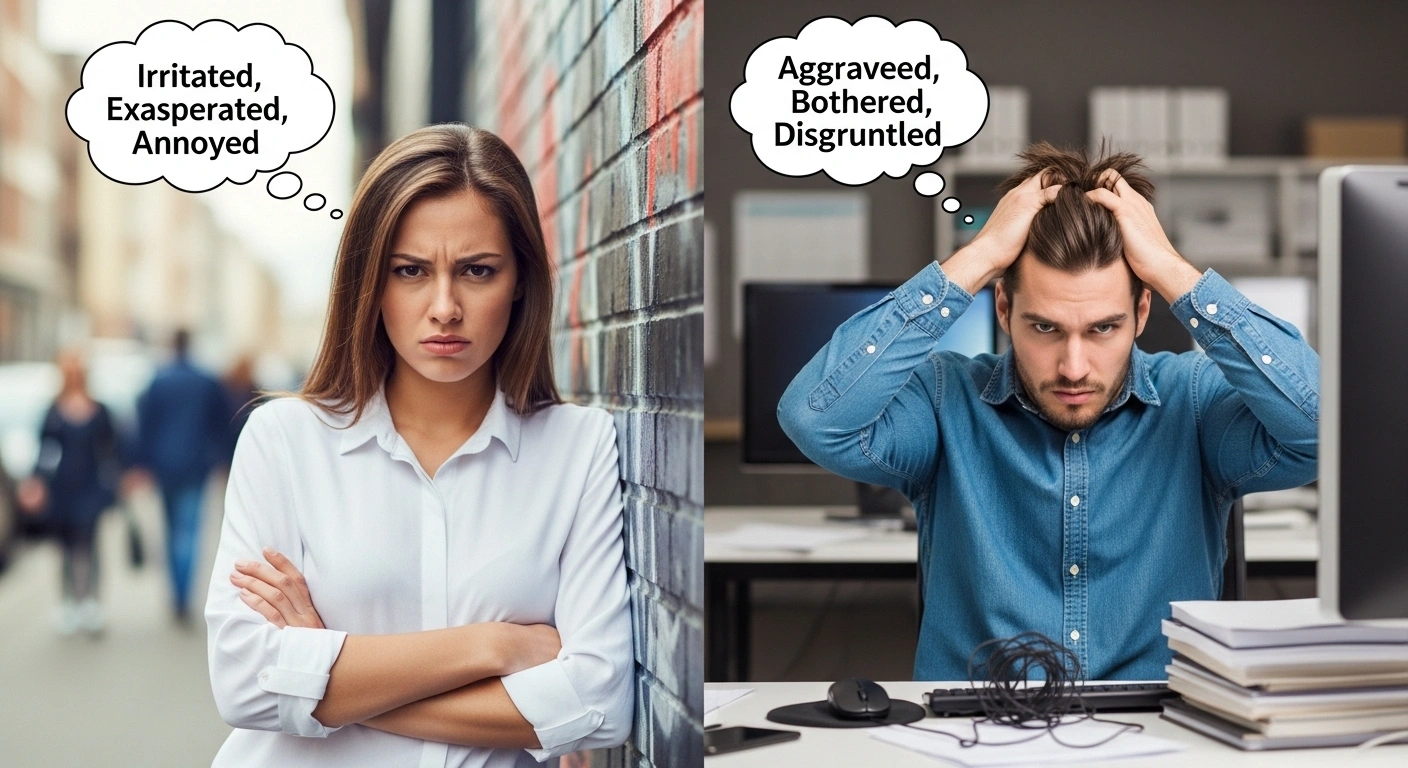
Synonyms for annoyed can turn even the simplest feeling into a powerful expression. Imagine you’re sitting in class, trying to concentrate, when the student next to you starts tapping his pen. The repeated Taping sounds sweet. Your patience begins to crack. You’re not just annoyed, you’re irritated, distracted, maybe even a little exasperated. That small moment shows how one feeling can have many shades—and that’s where synonyms for annoyed truly shine.
When you rely on just one word like “annoyed,” your language feels limited, almost like repeating the same note again and again. But when you explore synonyms for annoyed, your expression becomes vivid and precise. Instead of saying “I am annoyed,” you can say “I am irked” by minor habits, “I am frustrated” by constant interruptions, or “I am fed up” with repeated noise. Each word adds clarity and emotion, making your message stronger and more engaging.
Mastering synonyms for annoyed is not just about learning new words—it’s about upgrading your communication. It helps you sound more natural, more confident, and more like a native speaker. Your sentences gain depth, your tone becomes expressive, and your thoughts come alive with meaning.
Why Learners Must Know These Words
Words build bridges. Words build walls. The right word stops a fight. The wrong word starts one. Learners need these synonyms for confidence. You speak with power. You write with clarity. Experts need these words for precision. Teachers, doctors, leaders, and friends all use them. In society, people trust you when you name your feelings with care. You sound smart, calm and in control. That is why these words matter.
Pronunciation
Annoyed
- US: /uh-NOYD/
- UK: /uh-NOYD/
Irritated
- US: /IR-ih-tay-tid/
- UK: /IR-ih-tay-tid/
The Big Difference: Annoyed, Angry, and Irritated
These words live in the same family. They are not twins. They are cousins.
- Annoyed means a small thing bothers you. A fly buzzes near your ear. You feel annoyed.
- Angry means strong feeling burns inside you. A friend breaks your trust. You feel angry.
- Irritated means the bother grows bigger. Your shoe rubs your skin. You feel irritated.
- Frustrated means a wall blocks your path. You cannot open a jar. You feel frustrated.
- Aggravated means the problem repeats. The noise never stops. You feel aggravated.
Examples in sentences:
- She felt annoyed when he clicked his pen.
- He felt angry when his friend broke his toy.
- The tag irritated her neck.
- He felt frustrated with the puzzle.
- The loud music aggravated her headache.
50 Synonyms for Annoyed with Power Sentences
- Angry – She was angry when he took her seat.
- Mad – He got mad at the broken game.
- Irritated – The loud talk irritated the librarian.
- Frustrated – She felt frustrated with the slow computer.
- Upset – He was upset about the lost ticket.
- Bothered – The noise bothered the baby.
- Disturbed – The phone call disturbed his sleep.
- Troubled – The bad news troubled her mind.
- Cross – Mom got cross when he lied.
- Cranky – The tired child grew cranky.
- Grumpy – He woke up grumpy and frowned at everyone.
- Testy – The hot day made her testy.
- Touchy – He was touchy after the bad grade.
- Peevish – Her peevish voice filled the room.
- Grouchy – The old man shouted grouchy words at the kids.
- Crabby – She got crabby in the long line.
- Snappish – His snappish reply hurt her feelings.
- Huffy – She gave a huffy sigh and walked away.
- Sore – He was sore about the missed party.
- Riled – The insult riled the crowd.
- Ticked off – The long delay ticked her off.
- Fed up – He was fed up with the messy room.
- Wound up – The bad traffic wound her up.
- Worked up – He got worked up over the hard test.
- Heated – Their heated argument woke the neighbors.
- Furious – She was furious at the cheat.
- Livid – Dad was livid about the broken window.
- Irate – The irate customer yelled at the clerk.
- Incensed – The lie incensed her.
- Infuriated – The theft infuriated the store owner.
- Fuming – He was fuming after the big fight.
- Seething – She was seething with quiet rage.
- Aggravated – The delay aggravated her pain.
- Exasperated – The teacher was exasperated by the noise.
- Peeved – He was peeved about the cold food.
- Irked – The mess irked her.
- Miffed – She was miffed about the forgotten name.
- Displeased – The loss displeased the coach.
- Disgruntled – The disgruntled worker quit his job.
- Ruffled – The joke ruffled his calm mood.
- Angered – The insult angered the team.
- Enraged – The bully enraged the small boy.
- Provoked – The teasing provoked her tears.
- Harassed – The calls harassed her all night.
- Unsettled – The strange noise unsettled the dog.
- Bugged – The fly bugged him during lunch.
- Nagged – Her brother nagged her all afternoon.
- Vexed – The hard question vexed the class.
- Rattled – The surprise rattled her.
- Outraged – The lie outraged the public.
Common Examples in Culture
Books:
- Pride and Prejudice by Jane Austen, 1813, Romance. Elizabeth Bennet feels vexed by Mr. Darcy’s pride.
- A Christmas Carol by Charles Dickens, 1843, Novella. Ebenezer Scrooge is grouchy and cranky at Christmas.
- Harry Potter and the Order of the Phoenix by J.K. Rowling, 2003, Fantasy. Dolores Umbridge makes Harry feel irritated every day.
Movies:
- The Incredibles, 2004, USA. Bob Parr feels frustrated and irked by his boring office job.
- Office Space, 1999, USA. Workers feel disgruntled and fed up with their boss.
- Anger Management, 2003, USA. A man learns to control his angry and annoyed feelings.
- Falling Down, 1993, USA. A man feels aggravated by every small problem in the city.
Persons:
- Gordon Ramsay acts irate and furious on his cooking shows.
- Oscar the Grouch from Sesame Street lives in a trash can and stays grouchy all day.
Why People Get Confused
People mix up these words because the differences are small. Many think irritated and annoyed mean the same thing. They do not. Annoyed is light. Irritated is stronger. Some say angry when they mean frustrated. That causes big problems. Non-native speakers face trouble because direct translations lack the same power. British English and American English also use different words. One country says ticked off. Another says cheesed off. The strength scale changes from person to person. One person says annoyed. Another person says furious for the same event.
Difference and Similarity Table
| Feature | Annoyed | Irritated |
|---|---|---|
| Strength | Mild | Medium |
| Cause | One small thing | Repeated or physical thing |
| Feeling | In your mind | In your mind or body |
| Time | Short | Lasts longer |
| Example | Loud pen tap | Scratchy shirt tag |
| Similarity | Both mean something bothers you | Both mean something bothers you |
Which Synonym Wins in What Situation?
- Angry / Mad – Use these for strong feelings. A friend lies. A thief steals. These words carry fire.
- Irritated / Irked / Peeved – Use these for daily problems. A pen taps. A line moves slow. These words stay polite.
- Frustrated – Use this when a wall blocks you. You lose your keys. You fail a level in a game.
- Exasperated / Fed up – Use these when patience dies. A child ignores you ten times. A mess never gets cleaned.
- Furious / Livid / Infuriated – Use these for serious wrongs. Someone cheats you. Someone hurts your family.
- Cranky / Grouchy / Testy – Use these for bad moods. You miss sleep. You miss a meal. These words describe temporary grumpiness.
- Seething / Fuming – Use these when someone hides rage. They smile on the outside. They burn on the inside.
- Disgruntled – Use this for long-term unhappiness. A worker hates his job for years. A citizen hates the government.
- Ticked off / Worked up – Use these with friends. They sound casual and modern.
- Outraged – Use this for public scandals. The whole community reacts.
Metaphors and Similes
- Metaphor: His anger was a boiling pot. (Furious)
- Simile: She was as cranky as a hungry bear. (Cranky)
- Metaphor: Frustration was a locked door in his mind. (Frustrated)
- Simile: He fumed like a train blowing steam. (Fuming)
- Metaphor: Her patience was a thin ice sheet. (Exasperated)
Connotative Meanings
| Synonym | Feeling | Example |
|---|---|---|
| Peeved | Mild and neutral | “He was peeved about the delay.” |
| Disgruntled | Strong and negative | “The disgruntled guard slept at his post.” |
| Exasperated | Negative and tired | “The exasperated mom counted to three.” |
| Cranky | Negative but soft | “The cranky baby needed a nap.” |
| Outraged | Strong and negative | “The outraged crowd demanded justice.” |
| Fed up | Strong and negative | “She was fed up with the excuses.” |
Idioms and Proverbs
- Get someone’s goat – This means to annoy someone.
- Example: “His humming gets my goat every morning.”
- Rub someone the wrong way – This means to irritate someone.
- Example: “That new student rubs me the wrong way.”
- Drive someone up the wall – This means to make someone very annoyed.
- Example: “That loud music drives me up the wall.”
- Get on someone’s nerves – This means to bother someone.
- Example: “His jokes get on my nerves.”
- Bite someone’s head off – This means to answer with sharp anger.
- Example: “I asked one question and she bit my head off.”
- Like a bear with a sore head – This means very cranky.
- Example: “Stay away from Dad. He is like a bear with a sore head today.”
- Have a chip on one’s shoulder – This means to get angry easily.
- Example: “He has a chip on his shoulder since he lost the game.”
- At the end of one’s rope – This means fully exasperated.
- Example: “After the third broken plate, she was at the end of her rope.”
Works in Literature
- Pride and Prejudice, Romance, Jane Austen, 1813
- A Christmas Carol, Novella, Charles Dickens, 1843
- The Catcher in the Rye, Coming-of-age, J.D. Salinger, 1951
- Moby-Dick, Adventure, Herman Melville, 1851
- Wuthering Heights, Gothic fiction, Emily Brontë, 1847
- Harry Potter and the Order of the Phoenix, Fantasy, J.K. Rowling, 2003
Movies Featuring Annoyance
- Falling Down, 1993, USA
- Office Space, 1999, USA
- The Incredibles, 2004, USA
- Network, 1976, USA
- Horrible Bosses, 2011, USA
- Anger Management, 2003, USA
- Groundhog Day, 1993, USA
- The Devil Wears Prada, 2006, USA
Frequently Asked Questions
Q1: What is the difference between annoyed and irritated?
A: Annoyed is mild. Irritated is stronger and lasts longer.
Q2: Is “ticked off” a synonym for annoyed?
A: Yes. It means annoyed or angry. It is casual. Use it with friends, not with your boss.
Q3: Which synonym should I use in a professional email?
A: Use frustrated, displeased, or irritated. Avoid mad, furious, or slang.
Q4: Can annoyed ever be positive?
A: No. Annoyed is negative. Friends joke about it, but the feeling itself is not happy.
Q5: Why does English have so many synonyms for annoyed?
A: English loves detail. Many words came from French, Latin, and German. More words give you more power.
How These Synonyms Help Your World
These words change your daily life. At school, you tell a teacher you feel frustrated with homework. The teacher helps you. At home, you tell your brother he bugs you. He stops. At work, you say you are displeased with a plan. Your boss listens. When you name your feelings with the right word, people understand you faster. They respect you more. You avoid fights. You build trust. These fifty words are tools. Use them. Your world becomes smoother. Read more about synonyms here.
Final Words
You now own fifty power words. Do not hide them. Use irked when a pen taps. Furious when someone cheats and fed up when patience dies. Each word is a weapon against confusion. Each word is a bridge to understanding. Speak with courage. Write with clarity. Your English will shine. Read more on synonyms here..
Conclusion
You started this blog with one word: annoyed. You now hold fifty synonyms for annoyed in your hands. These words turn boring speech into powerful speech. They turn weak writing into strong writing. Young learners gain confidence. New speakers gain precision. Remember the tapping pen. Remember the buzzing fly. Now you have the exact word for every bother. You can describe your feelings with power and clarity. Your friends will understand you. Your teachers will respect you. Keep practicing. Keep speaking. Your English journey never ends, but today you took a giant step forward.

The author is a Ph.D scholar and writes on multiple topics of interests related to science, technology, society, history etc. The purpose behind all this stuff is to raise public awareness in different domains.