Introduction
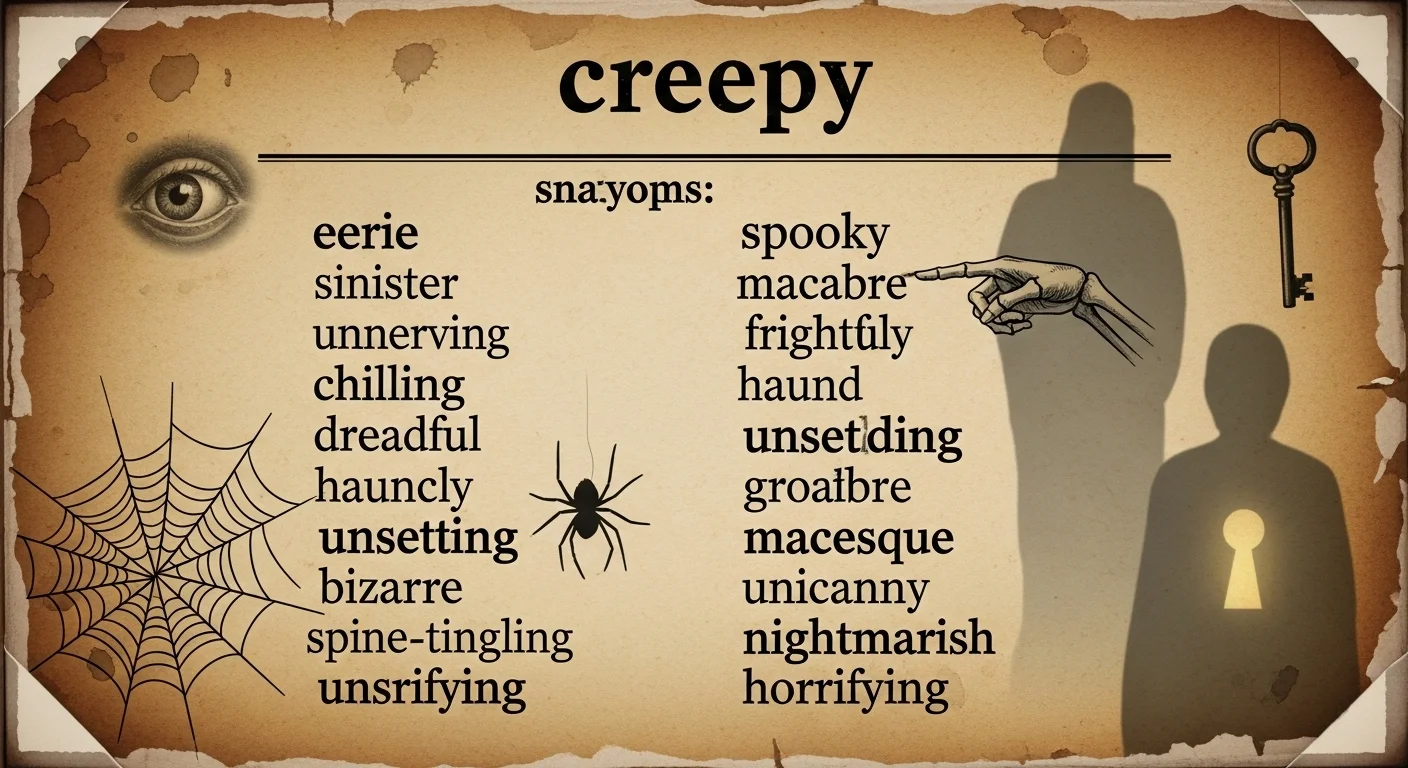
Synonyms for creepy help you describe scary feelings in a fun and clear way. Picture yourself walking home alone at night. The streetlights flicker, shadows move on the walls, and suddenly you hear a strange sound behind you. Right away, your heart starts beating fast and your skin feels cold. That spooky feeling is called creepy—and using synonyms for creepy helps you explain it even better.
The word “creepy” is used for things that make you feel uneasy, scared, or uncomfortable. It comes from the word “creep,” which means to move slowly and quietly, like a spider or a shadow in the dark. When something is creepy, it gives you goosebumps. It makes you turn around and check again. Even after it is gone, the feeling can stay in your mind. That’s why learning synonyms for creepy makes your stories more interesting and full of mystery.
Why should you care about synonyms for creepy? Experts need rich vocabulary to connect with audiences. Learners need variety to sound natural and confident. In our society, storytelling, marketing, and daily conversation all demand expressive language. Synonyms for creepy help you avoid boring repetition and paint vivid mental images.
Now, let us explore how these words sound around the world.
How to Pronounce “Creepy”
US Pronunciation: /ˈkriːpi/ (KREE-pee)
UK Pronunciation: /ˈkriːpi/ (KREE-pee)
Both American and British speakers say it the same way! The word has two syllables. The first syllable “cree” sounds like “kree” (rhymes with “see”), and the second syllable “py” sounds like “pee.”
Now that you know how to say it, let us dive into the heart of this article. What makes these synonyms for creepy special? How do they differ from one another? And when should you use each one? Let us find out!
Find the difference
Eerie: The Ghostly Side of Creepy
Eerie describes something strange and frightening, often in a supernatural or mysterious way. It feels like the air has gone cold for no reason.
- Eerie – The abandoned house had an eerie silence that made everyone nervous.
- Spooky – The old cemetery at midnight was incredibly spooky and full of shadows.
- Uncanny – Her ability to guess the future was uncanny and slightly terrifying.
- Weird – There was something weird about the way the doll’s eyes followed you.
- Strange – A strange fog rolled in, hiding everything in white mystery.
- Unsettling – The painting on the wall was deeply unsettling and hard to look at.
- Disturbing – The movie had a disturbing scene that stayed in my dreams.
- Frightening – The clown’s laugh was more frightening than funny.
- Scary – Walking through the dark forest alone was really scary.
- Hair-raising – The sound of footsteps behind me was absolutely hair-raising.
Sinister: The Dark and Threatening Side
Sinister suggests something evil or harmful is hiding beneath the surface. It feels dangerous.
- Sinister – The man in the black coat had a sinister smile that warned of trouble.
- Menacing – The dark clouds looked menacing, as if a storm wanted to swallow the town.
- Ominous – The black cat crossing the road felt like an ominous sign.
- Threatening – His threatening stare made everyone in the room freeze.
- Foreboding – She had a foreboding feeling that something terrible was about to happen.
- Macabre – The museum displayed macabre skeletons that fascinated and horrified visitors.
- Grim – The grim expression on his face told us the news was bad.
- Ghastly – The ghastly sight of the haunted mirror reflected something not human.
- Gruesome – The horror film showed gruesome scenes that made people cover their eyes.
- Horrid – The horrid smell coming from the basement made us run upstairs.
Unnerving: The Anxiety-Inducing Side
Unnerving describes things that make you lose your calm and confidence. They chip away at your peace of mind.
- Unnerving – The phone rang at 3 AM, which was deeply unnerving.
- Disquieting – There was a disquieting emptiness in the room, as if someone had just left.
- Troubling – The troubling whisper in the wind made the children huddle together.
- Worrisome – The worrisome creaking of the floorboards kept us awake all night.
- Alarming – The sudden power cut was alarming during the thunderstorm.
- Chilling – His chilling words echoed in the empty hallway.
- Bloodcurdling – A bloodcurdling scream came from the abandoned hospital.
- Petrifying – The sight of the snake was petrifying; I could not move an inch.
- Terrifying – The roller coaster drop was terrifying but also exciting.
- Horrifying – The horrifying truth about the ghost story finally came to light.
Weird: The Odd and Bizarre Side
Weird covers the strange, unusual, and hard-to-explain things that give you that creepy feeling.
- Bizarre – The bizarre carnival had mirrors that showed your worst fears.
- Freaky – That freaky coincidence made us wonder if fate was playing games.
- Creepy-crawly – The creepy-crawly insects in the attic sent shivers down my spine.
- Slimy – The slimy creature in the pond looked like it came from another planet.
- Sleazy – The sleazy hotel room had stains on the walls and a broken lock.
- Squalid – The squalid basement was filled with mold and forgotten secrets.
- Dingy – The dingy alleyway smelled of danger and hidden stories.
- Murky – The murky water hid what lurked beneath the surface.
- Shadowy – A shadowy figure stood at the end of the hall, never moving closer.
- Gloomy – The gloomy castle on the hill looked like it swallowed happiness whole.
Haunting: The Lingering and Memorable Side
Haunting describes things that stay with you, echoing in your mind long after the moment has passed.
- Haunting – The haunting melody played on a broken piano in the empty room.
- Melancholy – There was a melancholy beauty in the abandoned garden at dusk.
- Somber – The somber atmosphere of the old church felt heavy with history.
- Morbid – His morbid curiosity about graveyards worried his friends.
- Wicked – The wicked witch in the story cast spells that twisted reality.
- Diabolical – The villain had a diabolical plan to control the city.
- Demonic – The demonic laughter from the attic made everyone leave the house.
- Satanic – Rumors of satanic rituals in the forest kept villagers indoors at night.
- Nightmarish – The nightmarish landscape looked like a painting from a fever dream.
- Otherworldly – The otherworldly glow of the northern lights felt both beautiful and creepy.
Famous Examples in Movies, Books, and Real Life
Movies:
- The Shining (1980, USA) – Jack Nicholson’s performance is the definition of creepy.
- The Silence of the Lambs (1991, USA) – Hannibal Lecter is a masterclass in sinister charm.
- It (2017, USA) – Pennywise the clown brings creepy to terrifying new levels.
- The Conjuring (2013, USA) – Based on real events, this film is deeply unsettling.
- Hereditary (2018, USA) – A modern horror film that redefines eerie family drama.
- Get Out (2017, USA) – Jordan Peele’s social horror is brilliantly unsettling.
- The Babadook (2014, Australia) – A haunting tale of grief and monsters.
- Rosemary’s Baby (1968, USA) – A slow-burn ominous thriller about motherhood and evil.
- Let the Right One In (2008, Sweden) – A chilling vampire story with heart.
Books:
- Dracula by Bram Stoker (Gothic Horror, 1897) – The original creepy vampire tale.
- Frankenstein by Mary Shelley (Science Fiction/Gothic, 1818) – A haunting story of creation and regret.
- The Tell-Tale Heart by Edgar Allan Poe (Short Story/Gothic, 1843) – A disturbing tale of guilt.
- The Haunting of Hill House by Shirley Jackson (Gothic Horror, 1959) – The house itself is eerie.
- It by Stephen King (Horror, 1986) – Pennywise remains the king of creepy clowns.
- The Exorcist by William Peter Blatty (Horror, 1971) – A terrifying story of possession.
- Coraline by Neil Gaiman (Dark Fantasy, 2002) – A spooky children’s tale with button eyes.
- The Woman in Black by Susan Hill (Gothic Horror, 1983) – A chilling ghost story.
- The Turn of the Screw by Henry James (Gothic Horror, 1898) – A haunting tale of ambiguity.
Real-World Examples:
- The creepy abandoned island of Poveglia in Italy, once a quarantine station.
- The eerie “Bloop” sound recorded in the Pacific Ocean in 1997.
- The unsettling “Dyatlov Pass Incident” where hikers died under mysterious circumstances in 1959.
- The ominous “Mothman” sightings in Point Pleasant, West Virginia, during the 1960s.
Why People Get Confused About These Words
Many people mix up synonyms for creepy because the feelings they describe are so similar. Here is why confusion happens:
Similar Emotions, Different Flavors: All these words make you feel fear or unease, but each has a unique taste. Eerie feels ghostly, while sinister feels evil. Spooky is fun-scary, but horrifying is deeply traumatic.
Context Matters: A haunted house is spooky on Halloween but terrifying if you are alone at midnight. The same situation changes the word you need.
Intensity Levels: Words like weird and strange are mild. Words like bloodcurdling and petrifying are extreme. Using the wrong intensity makes your sentence sound odd.
Cultural Differences: In some cultures, ghosts are spooky fun. In others, they are diabolical threats. Your background shapes which word feels right.
Comparing the Synonyms: Differences and Similarities
Let us look at how these synonyms for creepy compare to one another without using a table format.
Eerie versus Spooky: Both describe strange, frightening situations. However, eerie feels more serious and mysterious, like fog over a graveyard. Spooky feels lighter and more playful, like a Halloween decoration. Eerie makes you hold your breath. Spooky makes you laugh nervously.
Sinister versus Menacing: Both suggest danger. Sinister hints at hidden evil, like a villain’s quiet smile. Menacing is more direct and visible, like a growling dog. Sinister whispers. Menacing shouts.
Unnerving versus Disturbing: Both break your peace of mind. Unnerving slowly chips away at your confidence, like a dripping tap. Disturbing hits harder, like a shocking image you cannot forget.
Haunting versus Melancholy: Both linger in your memory. Haunting feels ghostly and unsettling. Melancholy feels sad and beautiful. A haunting song gives you chills. A melancholy song makes you cry.
Weird versus Bizarre: Both mean strange. Weird is everyday strange. Bizarre is extreme and almost unbelievable. A weird neighbor collects spoons. A bizarre neighbor collects human teeth.
Which Synonym Works Best in What Situation?
Eerie: Use this when describing places, sounds, or atmospheres that feel supernatural. Perfect for ghost stories and abandoned locations.
Spooky: Best for fun, lighthearted fear. Great for Halloween parties, children’s stories, and playful warnings.
Sinister: Ideal for describing people, plans, or situations with hidden evil. Use it for villains, conspiracies, and dark intentions.
Unnerving: Perfect for situations that slowly destroy your comfort. Use it for awkward silences, strange coincidences, and psychological tension.
Terrifying: Use when you want maximum fear. Perfect for life-threatening situations, nightmares, and extreme horror.
Haunting: Best for things that stay with you emotionally. Use it for memories, melodies, and images you cannot shake.
Weird: The most flexible word. Use it for anything strange or unusual in daily conversation.
Chilling: Perfect for words, sounds, or realizations that make you freeze. Use it for bad news, threats, and shocking truths.
Macabre: Best for dark, death-related topics. Use it for art, humor, or stories that dance with mortality.
Ominous: Ideal for signs and warnings of future danger. Use it for dark clouds, bad feelings, and threatening symbols.
Metaphors and Similes with Creepy Synonyms
Metaphors:
- The old mansion was a graveyard of forgotten dreams.
- His smile was a spider crawling up your spine.
- The silence in the room was a tomb waiting for its next guest.
- Her stare was a knife cutting through warm air.
- The night wrapped around the town like a shroud.
Similes:
- The fog was as eerie as a whisper in an empty church.
- His voice was as chilling as ice water down your back.
- The abandoned house looked as spooky as a skeleton at a birthday party.
- Her prediction was as uncanny as a cat predicting the rain.
- The scene was as disturbing as a smile without eyes.
Connotative Meanings: Positive, Negative, and Neutral
Positive Connotations:
Some synonyms for creepy can be exciting! Spooky is fun at Halloween. Haunting can describe beautiful music. Weird can mean creative and unique. Eerie can add thrilling mystery to a story.
Example: “The haunting melody of the violin made the concert unforgettable.” (Positive – beautiful and memorable)
Negative Connotations:
Most synonyms for creepy carry bad feelings. Sinister, gruesome, diabolical, and horrifying describe things we want to avoid. They warn us of danger, evil, or trauma.
Example: “The gruesome details of the crime made the jury cry.” (Negative – traumatic and awful)
Neutral Connotations:
Some words sit in the middle. Strange, odd, and unusual simply mean different from normal. They do not always scare you. They just surprise you.
Example: “There was a strange smell coming from the kitchen, but it was just burnt toast.” (Neutral – odd but harmless)
Idioms and Proverbs Related to Creepy Synonyms
- “Make someone’s blood run cold” – The sight of the ghost made my blood run cold.
- “Give someone the creeps” – That old man really gives me the creeps.
- “A skeleton in the closet” – Every family has a skeleton in the closet.
- “Like a deer in the headlights” – She stood there, petrified like a deer in the headlights.
- “The devil is in the details” – The plan seemed simple, but the devil was in the details.
- “Over my dead body” – “You want to enter that haunted house? Over my dead body!“
- “Night and day” – The difference between the two suspects was like night and day.
- “Dark horse” – He was a dark horse in the competition, surprising everyone.
- “Bite the dust” – In horror movies, the first character always bites the dust.
- “Walking on eggshells” – After the argument, everyone was walking on eggshells.
Literary Works Featuring Creepy Themes
- Dracula – Gothic Horror – Bram Stoker – 1897
- Frankenstein – Science Fiction/Gothic – Mary Shelley – 1818
- The Tell-Tale Heart – Short Story/Gothic – Edgar Allan Poe – 1843
- The Haunting of Hill House – Gothic Horror – Shirley Jackson – 1959
- It – Horror – Stephen King – 1986
- The Exorcist – Horror – William Peter Blatty – 1971
- Coraline – Dark Fantasy – Neil Gaiman – 2002
- The Woman in Black – Gothic Horror – Susan Hill – 1983
- The Turn of the Screw – Gothic Horror – Henry James – 1898
Movies Based on Creepy Themes
- The Shining – 1980 – USA
- The Silence of the Lambs – 1991 – USA
- It – 2017 – USA
- The Conjuring – 2013 – USA
- Hereditary – 2018 – USA
- Get Out – 2017 – USA
- The Babadook – 2014 – Australia
- Rosemary’s Baby – 1968 – USA
- Let the Right One In – 2008 – Sweden
Frequently Asked Questions
Q1: What is the strongest synonym for creepy?
A: Bloodcurdling and petrifying are among the strongest. They describe extreme fear that paralyzes you. Use them when you want readers to feel genuine terror.
Q2: Can creepy synonyms be used in positive ways?
A: Yes! Spooky is fun at Halloween. Haunting can describe beautiful art. Weird often means creative and original. Context changes everything.
Q3: What is the difference between creepy and scary?
A: Creepy is subtle and lingering. It makes your skin crawl. Scary is direct and immediate. A jump scare in a movie is scary. A doll that watches you sleep is creepy.
Q4: Which synonym should I use for writing horror stories?
A: There are plenty of words like, eerie for atmosphere. You can call a villain as sinister or a psychological tension can be unsettling. Moments of horror can be bloodcurdling. We can mix them for maximum impact.
Q5: Are creepy words useful in everyday conversation?
A: Absolutely! Instead of saying “that was weird,” say “that was uncanny” or “that gave me the creeps.” It makes your speech more colorful and memorable.
How Creepy Synonyms Help the World Around Us
Synonyms for creepy are not just for horror fans. They help teachers explain emotions to children. Therapists, to describe anxiety and fear and writers to create stories. They help marketers design Halloween campaigns and thriller movie trailers. They help friends share ghost stories around campfires.
In a world full of stories, the right word at the right time builds bridges between minds. When you say something is eerie instead of just “scary,” you paint a clearer picture. You help others feel what you feel. That is the true power of language. Read more on synonyms here.
Final Words for Creepy Synonyms
Learning synonyms for creepy opens a door to richer, more exciting communication. These words are tools in your vocabulary toolbox. Some are sharp like knives. Some are soft like shadows. All of them help you express the complex, fascinating feeling of fear and unease.
Do not be afraid to experiment. Try sinister in a sentence today. Drop uncanny into a conversation tomorrow. The more you use these words, the more natural they become. Your writing will grow stronger. Your stories will grow deeper. And your readers will keep coming back for more.
Conclusion
Synonyms for creepy are super helpful if you enjoy playing with words. Using the word “creepy” repeatedly, you can use different synonyms for creepy like eerie, spooky, scary, or chilling to make your conversation more impactful. For example, whether you are writing a short horror story, telling a campfire tale, or describing a strange moment, these synonyms for creepy give you many exciting choices.
Also, good writers do not repeat the same word all the time. Instead, they try new words and explore different ways to express feelings. That’s why learning synonyms for creepy can make your writing stronger and more lively. As you start using these synonyms for creepy, your words will feel full of mystery, suspense, and imagination. So go ahead, try them out, and let your language come alive! For more information click here.

The author is a Ph.D scholar and writes on multiple topics of interests related to science, technology, society, history etc. The purpose behind all this stuff is to raise public awareness in different domains.