Table of Contents
- What Are Synonyms for Stupid?
- Why Knowing These Synonyms Matters for Everyone
- How to Say “Stupid” Correctly
- Dumb vs. Stupid: What’s the Real Difference?
- 50 Synonyms for Stupid: Five Easy Sections
- Famous Examples in Movies, Books, and Real Life
- Why People Get Confused About These Words
- Which Synonym Fits Which Situation?
- Metaphors and Similes That Bring These Words to Life
- The Hidden Meanings Behind These Words
- Idioms and Sayings About Being Foolish
- Frequently Asked Questions
- How These Words Are Searched Online
- Final Thoughts on Synonyms for Stupid
- Conclusion
What Are Synonyms for Stupid?
Synonyms for stupid are words that mean someone is not smart, slow to understand, or lacking good sense. When I was in school, my teacher told us a story about a boy who touched a hot stove twice because he forgot it was hot. The class laughed, but the teacher said, “That was a foolish thing to do.” She did not use the word “stupid.” She used “foolish” instead. That day, I learned that English has many words for the same idea. Some sound soft and some sound harsh. Whereas some are funny. Some are serious.
Knowing these synonyms for stupid helps you pick the right word for the right moment. It also makes your English sound more natural and rich. Whether you are talking to a friend, writing an essay, or watching a movie, these words appear everywhere. In this guide, you will learn 50 of them, along with easy sentences, real examples, and tips on how to use them well.
Why Knowing These Synonyms Matters for Everyone
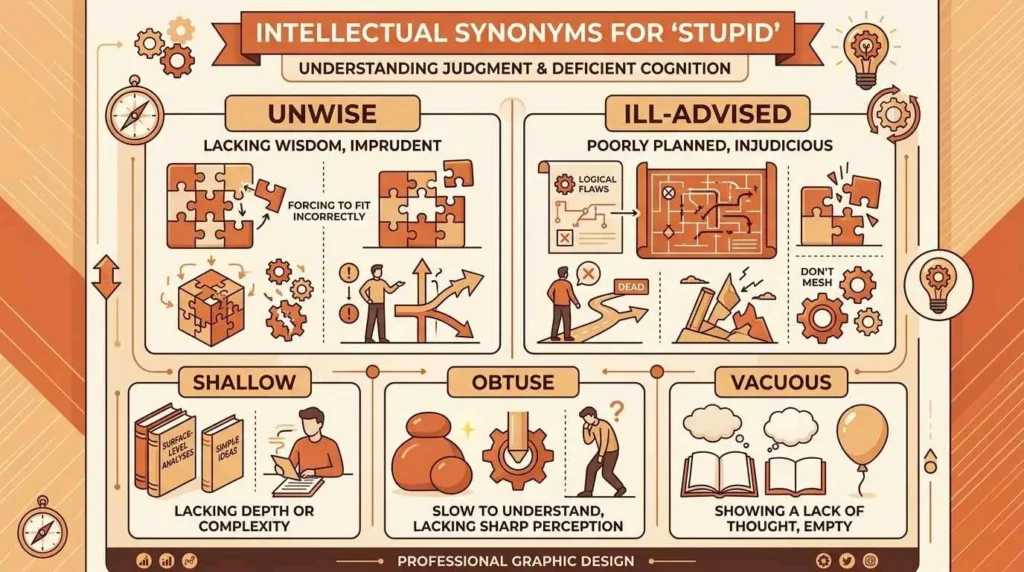
Synonyms for stupid are not just extra words to memorize. They are tools that help you express yourself better. For learners, knowing these words makes reading and listening easier. You will see them in books, hear them in songs, and spot them in conversations. For experts, these synonyms add color and precision to your writing and speech. A lawyer might say “unwise” instead of “stupid” to sound more professional. A comedian might say “dumb as a rock” to get a laugh. A parent might say “silly” to a child to keep the tone gentle. In society, the word you choose matters.
Calling someone “stupid” can hurt feelings. But saying “that was unwise” or “a bit dense” can soften the blow. These synonyms help you match your words to your audience. They also build your vocabulary, which boosts your confidence in exams, job interviews, and daily life. In short, learning synonyms for stupid is a small step that leads to big gains in how you communicate.
How to Say “Stupid” Correctly
Before we dive into the synonyms, let us make sure you can say the main word right.
Stupid
- US Pronunciation: /ˈstuːpɪd/ (STOO-pid)
- UK Pronunciation: /ˈstjuːpɪd/ (STYOO-pid)
The US version drops the “y” sound, while the UK version keeps it. Both are correct. Now, let us move to the main part of this article and explore the world of words that mean “not so smart.”
Dumb vs. Stupid: What’s the Real Difference?
Many people think “dumb” and “stupid” mean the same thing. They are close, but they are not twins. “Stupid” means someone lacks intelligence or good judgment. It is a broad word. “Dumb” also means lacking intelligence, but it can sound a bit softer in casual talk. However, “dumb” has another meaning: it can mean unable to speak. In old times, people used “dumb” to describe someone who could not talk. Today, that use is considered rude. So be careful. “Stupid” is more direct and often more hurtful. “Dumb” can be playful, like when a friend says, “That was a dumb idea,” but smiles while saying it.
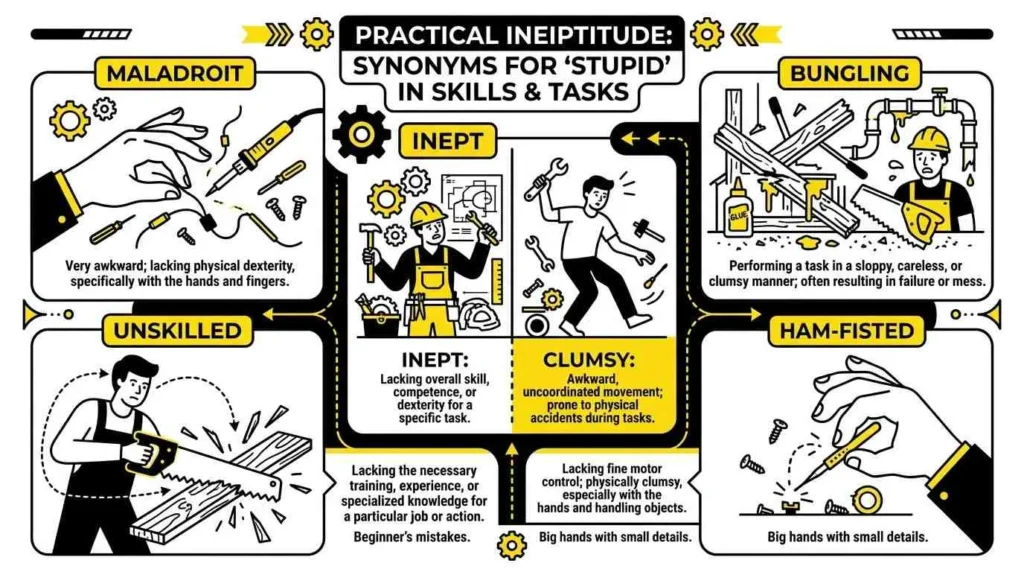
Both words can be insults, but “dumb” sometimes feels less sharp. Other related words include “foolish,” which focuses on bad choices rather than low intelligence. “Ignorant” means lacking knowledge, not lacking brain power. “Silly” is light and playful. “Dense” means slow to understand a hint. Each word carries its own shade of meaning. The key is to know your audience and pick the word that fits the mood.
50 Synonyms for Stupid: Five Easy Sections
Here are 50 synonyms for stupid, grouped into five sections of ten words each. Every word comes with a simple, interesting sentence to help you remember it.
Dumb Words: When Someone Just Does Not Get It
These words are common, casual, and easy to use.
- Dumb — He made a dumb mistake by leaving his keys in the car.
- Foolish — It was foolish to go out in the rain without an umbrella.
- Silly — She wore a silly hat to the party and made everyone laugh.
- Dense — He was too dense to notice she was upset.
- Thick — My brother is a bit thick when it comes to math.
- Slow — The student was slow to understand the new rule.
- Dim — The dim waiter brought soup instead of salad.
- Dull — The lecture was so dull that half the class fell asleep.
- Simple — He has a simple mind and trusts everyone he meets.
- Gullible — She was gullible enough to believe the fake news story.
Foolish Words: When Bad Choices Lead the Way
These words focus on poor judgment rather than low IQ.
- Unwise — It was unwise to spend all his money on video games.
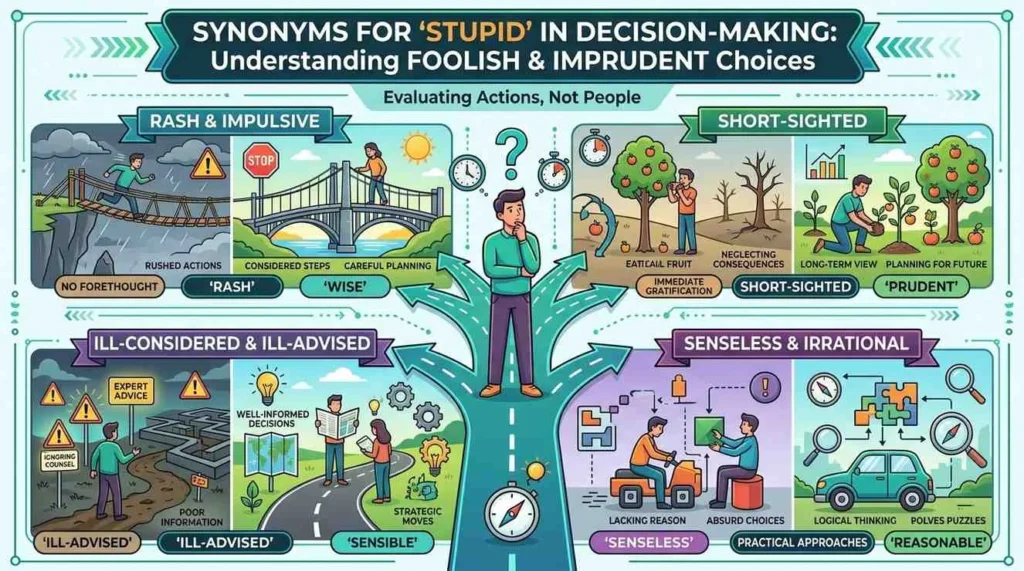
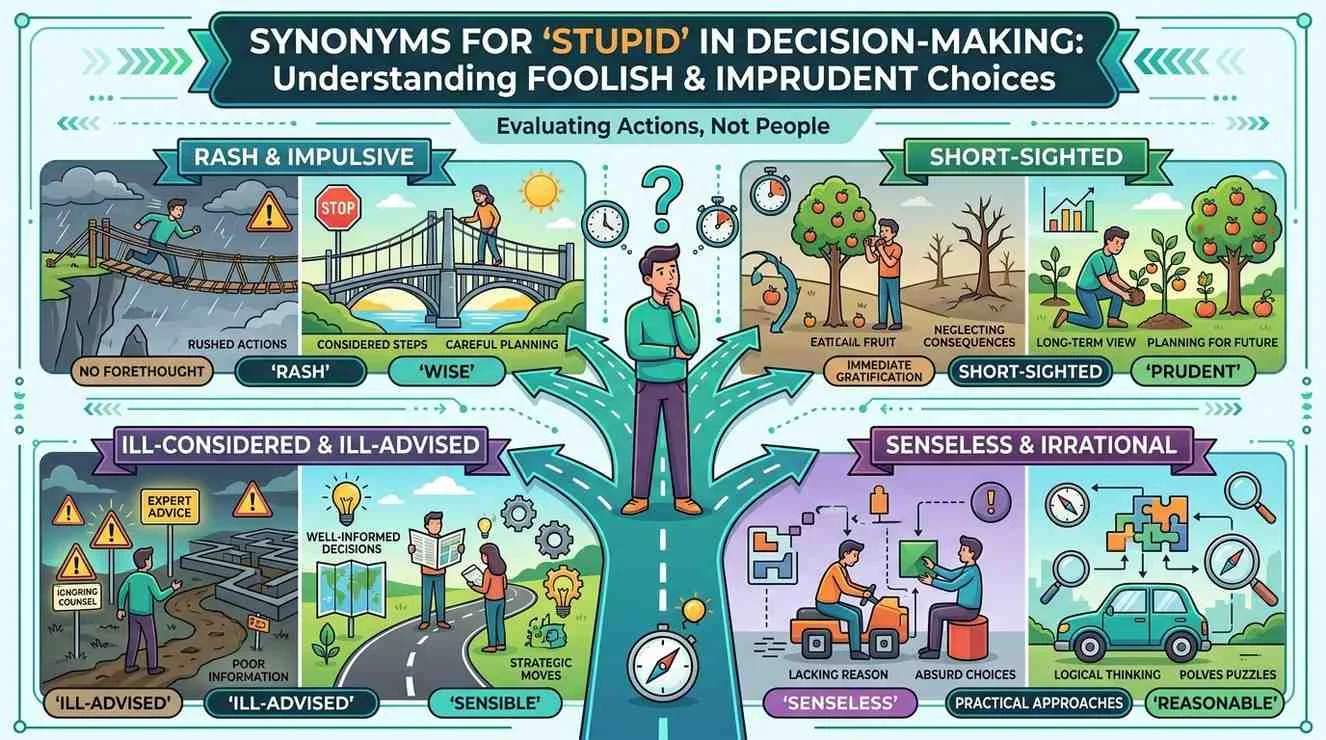
- Rash — Her rash decision to quit her job left her with no income.
- Reckless — Driving fast in the snow was reckless and dangerous.
- Thoughtless — His thoughtless comment hurt her feelings deeply.
- Careless — A careless error cost the team the championship.
- Imprudent — It was imprudent to share his password with a stranger.
- Indiscreet — Her indiscreet gossip spread all over the office.
- Injudicious — His injudicious remark at the meeting embarrassed everyone.
- Ill-advised — The ill-advised plan failed within the first hour.
- Misguided — His misguided attempt to help only made things worse.
Silly Words: When Things Get Light and Playful
These words are softer and often used in friendly or funny situations.
- Ridiculous — His ridiculous outfit made us all burst into laughter.
- Absurd — The idea that cats can fly is completely absurd.
- Ludicrous — Paying $100 for a cup of coffee is ludicrous.
- Preposterous — Her preposterous excuse did not fool anyone.
- Nonsensical — The poem was nonsensical but strangely beautiful.
- Wacky — His wacky inventions never worked, but they were fun to watch.
- Zany — The zany comedian slipped on a banana peel on stage.
- Goofy — The goofy puppy ran into the glass door twice.
- Loony — My loony aunt talks to her plants every morning.
- Kooky — Her kooky hairstyle turned heads wherever she went.
Dense Words: When the Brain Feels Like a Brick Wall
These words describe someone who is slow to catch on or hard to teach.
- Obtuse — He was too obtuse to understand her subtle hint.
- Oblivious — She was oblivious to the fact that everyone was staring at her.
- Unaware — He walked into the wrong classroom, completely unaware.
- Inattentive — The inattentive driver missed the stop sign and caused a crash.
- Oblivious — He was oblivious to the mess he left in the kitchen.
- Mindless — The mindless robot kept walking into the wall.
- Vacant — There was a vacant look in his eyes during the boring speech.
- Blank — She gave a blank stare when asked about her homework.
- Numb — After the shock, he felt numb and could not think clearly.
- Befuddled — The befuddled tourist could not read the map at all.
Imbecilic Words: When Things Get Harsh and Serious
These words are stronger and often used to criticize severely.
- Idiotic — His idiotic stunt could have broken his neck.
- Moronic — The moronic plan involved jumping off a roof into a pool.
- Imbecilic — His imbecilic behavior got him banned from the store.
- Asinine — The asinine rule forbade students from drinking water in class.
- Inane — The inane conversation about the weather lasted two hours.
- Fatuous — His fatuous smile showed he had no idea he was wrong.
- Cretinous — The cretinous vandal damaged the school library.
- Brain-dead — That brain-dead policy hurts more people than it helps.
- Half-witted — The half-witted scheme fell apart in five minutes.
- Doltish — His doltish attempt to fix the TV made it smoke.
Famous Examples in Movies, Books, and Real Life
Synonyms for stupid appear everywhere in pop culture. In the movie Forrest Gump, the famous line goes, “Stupid is as stupid does.” This means your actions show if you are foolish, not your words. In Game of Thrones, Ygritte tells Jon Snow, “You know nothing, Jon Snow,” which became a popular way to call someone clueless. The movie Elf, Buddy shouts, “You sit on a throne of lies!” to a fake Santa, showing how silly accusations can sound funny.
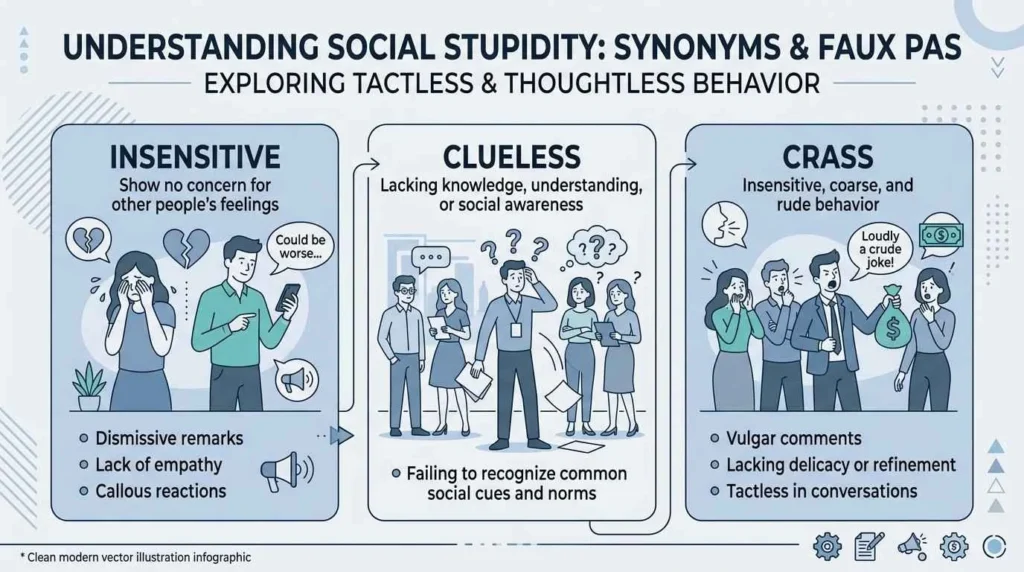
In Charlie Brown, Lucy often calls him a “blockhead,” a gentle synonym for stupid. In real life, sports commentators use “bonehead move” to describe a dumb play. The “village idiot” is a character from old stories and folklore, representing the foolish person everyone knows. These examples show that synonyms for stupid are not just dictionary words. They are living parts of our culture, used to entertain, teach, and connect.
Why People Get Confused About These Words
People often mix up synonyms for stupid because the differences are small but important. “Dumb” and “stupid” seem the same, but “dumb” can also mean silent. “Foolish” and “silly” both mean unwise, but “foolish” sounds more serious while “silly” sounds playful. “Ignorant” means lacking knowledge, not lacking brains. Calling someone “ignorant” is not the same as calling them “stupid.” “Dense” and “thick” both mean slow to understand, but “thick” is more British while “dense” is used everywhere. “Obtuse” is a fancy word that many people use wrong.
They think it just means stupid, but it really means slow to understand a hint or idea. “Moronic” and “idiotic” both come from old medical terms for mental disability, so using them as insults can be offensive. The confusion grows because movies and TV shows use these words loosely. A character might say “idiot” when they mean “careless.” This makes learners think the words are interchangeable. But they are not. Each synonym has its own home. Learning where each one belongs is the key to using them well.
Which Synonym Fits Which Situation?
Choosing the right synonym for stupid depends on your goal. Here is a quick guide.
- With friends: Use “dumb,” “silly,” or “goofy.” These are soft and friendly. “That was a dumb thing to say, but I still love you.”
- At work: Use “unwise,” “imprudent,” or “thoughtless.” These sound professional. “That was an unwise investment.”
- In writing: Use “obtuse,” “fatuous,” or “asinine.” These add style and precision. “His asinine argument fell flat.”
- When angry: Use “idiotic,” “moronic,” or “brain-dead.” These are strong and show emotion. “That was an idiotic decision!”
- With children: Use “silly” or “foolish.” These are gentle and teach without hurting. “That was a silly thing to do, sweetie.”
- In comedy: Use “wacky,” “loony,” or “ridiculous.” These invite laughter. “His loony plan to catch the mouse involved a rocket.”
The rule is simple: match the word to the mood and the person. A harsh word to a friend can wound. A soft word to a serious situation can sound weak. Pick with care.
Metaphors and Similes That Bring These Words to Life
Metaphors and similes make synonyms for stupid more vivid and fun.
Similes (using “like” or “as”):
- He is as dumb as a rock. (He has no sense at all.)
- She is as slow as molasses in January. (She takes forever to understand.)
- He is as thick as a brick. (He cannot grasp simple ideas.)
- She is as sharp as a marble. (She is not sharp at all.)
- He is like a garden hose with no water pressure. (He tries but has no brain power.)
Metaphors (direct comparisons without “like” or “as”):
- His brain is a sieve. (Everything leaks out; he forgets everything.)
- She is a lightbulb with no filament. (She cannot light up with ideas.)
- His mind is a blown fuse. (It stopped working completely.)
- She has a head full of feathers. (There is nothing solid in her head.)
- He is an elevator that does not reach the top floor. (He is missing a few brain cells.)
These figures of speech make English colorful. They also help you remember the words because they create pictures in your mind.
The Hidden Meanings Behind These Words
Every synonym for stupid carries a hidden feeling called a connotation. This is the emotional baggage a word brings with it.
Positive or Neutral:
- Silly — Can be cute or funny. “You are silly” often means “You make me laugh.”
- Simple — Can mean pure or honest. “He has a simple heart” is a compliment.
- Gullible — Can mean trusting, which is not always bad. “She is gullible but kind.”
Negative:
- Idiotic — Strong insult. It suggests the person is beyond help.
- Moronic — Very harsh. It comes from an old medical label, so it can offend.
- Cretinous — Extremely rude. Avoid this unless you want to start a fight.
Neutral:
- Dense — Just describes someone slow to catch on. Not kind, not cruel.
- Obtuse — A formal word for slow understanding. Used in academic or work settings.
- Unaware — Simply means not knowing. No blame attached.
The connotation changes with context. Calling a puppy “silly” is sweet. Calling a coworker “silly” after a big mistake is sarcastic. Always think about how your word will land before you throw it.
Idioms and Sayings About Being Foolish
English is full of idioms about stupidity. These phrases do not mean what they say literally, but everyone understands them.
- Not the sharpest tool in the shed — He is nice, but he is not the sharpest tool in the shed.
- A few fries short of a Happy Meal — That plan sounds like it is a few fries short of a Happy Meal.
- Not the brightest bulb in the box — She tried, but she is not the brightest bulb in the box.
- Not playing with a full deck — His behavior makes me think he is not playing with a full deck.
- A few sandwiches short of a picnic — He looked like he was a few sandwiches short of a picnic today.
Read More
- The lights are on but nobody is home — I asked her a question, but the lights were on and nobody was home.
- Has a screw loose — He must have a screw loose to do that.
- Could not pour water out of a boot with instructions on the heel — He failed the simplest task; he could not pour water out of a boot with instructions on the heel.
- Missing a few marbles — She is missing a few marbles to think that is a good plan.
- Dumb as a rock — He may be strong, but he is dumb as a rock.
Enjoy more
- Lost his marbles — I think Aunt May has lost her marbles; she has been talking to her plants lately.
- As slow as molasses in January — He is as slow as molasses in January during exams.
- Does not have all his ducks in a row — He forgot everything; he does not have his ducks in a row.
- A few cards short of a full deck — Jack may seem friendly, but he is a few cards short of a full deck.
- Not firing on all cylinders — She is not firing on all cylinders this morning.
These idioms add humor and creativity to your English. They also soften the blow when you need to say someone is not so smart. Instead of saying “you are stupid,” you can say “you are a few fries short of a Happy Meal” and get a laugh instead of a frown.
Frequently Asked Questions
Q: Is it okay to call someone “stupid” in English?
A: It is better to avoid it. “Stupid” is a strong insult and can hurt feelings. Use softer words like “silly” or “foolish” instead.
Q: What is the difference between “dumb” and “stupid”?
A: Both mean lacking intelligence, but “dumb” can also mean unable to speak. In casual talk, “dumb” sometimes feels softer than “stupid.”
Q: Are words like “moronic” and “idiotic” offensive?
A: Yes. These words come from old medical terms for mental disability. Using them as insults can be hurtful and is best avoided.
Q: Which synonym for stupid is best for beginners?
A: Start with “foolish,” “silly,” and “dumb.” These are common, easy to pronounce, and safe to use in most situations.
Q: Can “stupid” ever be used in a positive way?
A: Sometimes. In casual talk, friends might say “That is stupid good” to mean “extremely good.” But this is slang and not standard English.
How These Words Are Searched Online
People search for synonyms for stupid every day. Here are the top ways they look for these words on the internet:
- “Other words for stupid” — Learners want polite alternatives.
- “Synonyms for stupid person” — People need words for characters or descriptions.
- “Funny ways to say someone is dumb” — Users want idioms and jokes.
- “Is dumb offensive” — People check if the word is rude before using it.
- “Stupid synonyms for writing” — Writers need variety in their stories.
- “Soft words for stupid” — Parents and teachers want gentle terms for kids.
- “Formal synonyms for stupid” — Professionals need polite words for work emails.
- “Stupid idioms in English” — Learners want colorful expressions.
- “Difference between dumb and stupid” — People want to know which word fits where.
- “Stupid synonyms with examples” — Students need sentences to study.
These searches show that people do not just want a list. They want context, examples, and guidance on how to use each word well. That is exactly what this guide provides. For more synonyms on this topic, click here.
Final Thoughts on Synonyms for Stupid
Synonyms for stupid are more than just a vocabulary list. They are a window into how English speakers think, feel, and communicate. Each word carries a different weight, a different tone, and a different purpose. Learning them gives you power. You can soften a criticism, sharpen a joke, or add style to your writing. You can understand movies better, read books faster, and speak with more confidence. The key is to practice. Pick five words from this list and use them this week. Notice how people react. Notice how you feel. Over time, these words will become part of your natural English. And that is when you truly own them.
Conclusion
Synonyms for stupid in different contexts are some of the most useful words you can learn in English. They help you express yourself with precision, kindness, or humor, depending on what you need. From soft words like “silly” to strong words like “idiotic,” each one has its place. This guide gave you 50 synonyms, easy sentences, real examples, idioms, and tips on how to choose the right word. Keep this list close. Use it often. And watch your English grow stronger, richer, and more natural every single day. Click here for a video.

The author is a Ph.D scholar and writes on multiple topics of interests related to science, technology, society, history etc. The purpose behind all this stuff is to raise public awareness in different domains.