
Introduction: What Does Impact Mean?
Synonyms for impact help us explain how one action can change a person, a place, or the world. Imagine a teacher who helps a shy student speak with confidence. That small act may have a great impact on the student’s life. Similarly, a kind word can lift someone’s mood, while a careless remark can hurt their feelings. In both cases, one action creates a result.
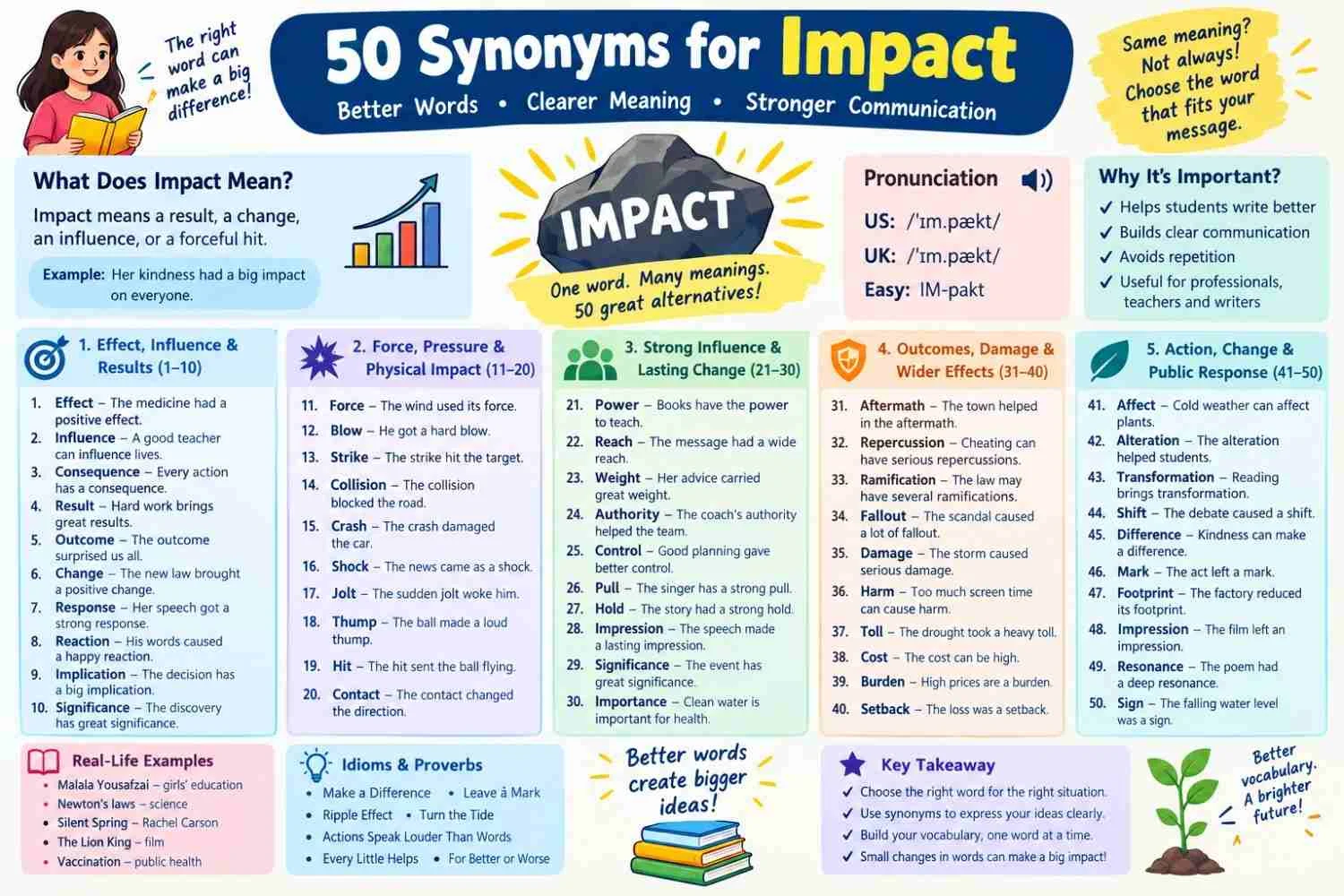
The word impact can mean an effect, a strong influence, or a forceful hit. Therefore, its best synonym depends on the situation. For example, a new law may have a major effect on society, while a ball may strike a window with great force. Learning synonyms for impact helps students, teachers, writers, and professionals express ideas clearly. Moreover, it makes everyday speech more interesting and helps us choose the right word for every message.
What Are the Synonyms for Impact?
Synonyms for impact are words with meanings close to impact. They help us describe results, changes, influence, and physical contact.
For example, effect describes a result, while influence shows how something changes a person’s thoughts or actions. Likewise, collision describes a crash between objects.
The right synonym makes your message clear and powerful. However, not every word fits every sentence. Understanding each word’s meaning is the key to good writing.
Why Are Impact Synonyms Important for Students and Experts?
Impact synonyms are useful because people need clear words to explain change and results.
- Students: They can improve essays, answers, stories, and speeches.
- Teachers: They can explain how lessons change students’ lives.
- Writers: They can avoid using the same word again and again.
- Scientists: They can describe the effects of heat, pollution, and new discoveries.
- Business owners: They can explain how a new plan affects sales.
- Community leaders: They can discuss how public decisions change people’s lives.
For example, a student may write, “The campaign had an impact.” A clearer sentence could be, “The campaign reduced plastic waste.” The second sentence tells readers what changed.
Thus, learning these words builds better speaking, reading, and writing skills.
How Do You Pronounce Impact in US and UK English?
The pronunciation of impact is almost the same in American and British English.
- US English: /ˈɪm.pækt/
- UK English: /ˈɪm.pækt/
- Easy pronunciation: IM-pakt
The first part, IM, receives the main stress.
As a noun, impact means an effect or a forceful hit. As a verb, it means to affect something or to strike it.
Examples:
- The storm had a strong impact on the town.
- The new rule may impact every student.
Now that we understand the word, let us explore 50 useful alternatives and learn when each one works best.
50 Synonyms for Impact With Meanings and Examples
The following words are grouped into five sections. Some describe results, while others focus on influence, change, or physical force.
Section 1: Effect, Influence, and Other Words for Results
1. Effect
Meaning: A result caused by an action or event.
Example: Every hour of practice had a positive effect on her game.
2. Influence
Meaning: The power to change someone’s thoughts or actions.
Example: A good teacher can influence every student in the class.
3. Consequence
Meaning: Something that happens because of an action.
Example: Every careless act can have a consequence.
4. Result
Meaning: The final outcome of an action.
Example: Daily exercise had a clear result: he became stronger.
5. Outcome
Meaning: The final result of an event or process.
Example: The outcome of the school contest made everyone proud.
6. Change
Meaning: A difference in a person, place, or thing.
Example: The new library brought a positive change to the school.
7. Response
Meaning: An action or feeling caused by something.
Example: Her speech caused a strong response from the audience.
8. Reaction
Meaning: The way someone acts or feels after an event.
Example: His kind words caused a happy reaction.
9. Consequence
Meaning: An effect that follows an action.
Example: One consequence of wasting water is a shortage for others.
10. Implication
Meaning: A possible effect or result of an action or decision.
Example: The new rule has an important implication for every student.
Quick tip: Use effect, result, and outcome when you discuss what happened. Choose influence when you mean the power to change a person or an idea.
Section 2: Force, Pressure, and Physical Impact
11. Force
Meaning: Strength that can move, stop, or change something.
Example: The force of the wind pushed the door open.
12. Blow
Meaning: A strong hit or strike.
Example: The boxer received a hard blow to the shoulder.
13. Strike
Meaning: A hit made with force.
Example: The hammer’s strike drove the nail into the wood.
14. Collision
Meaning: An event in which two objects crash into each other.
Example: The collision between the two cars blocked the road.
15. Crash
Meaning: A violent hit or accident.
Example: The crash damaged the front of the bus.
16. Shock
Meaning: A sudden event that causes surprise or distress.
Example: The sudden news came as a shock to the family.
17. Jolt
Meaning: A sudden, sharp movement or surprise.
Example: The sudden jolt woke the sleeping passenger.
18. Thump
Meaning: A heavy, dull hit or sound.
Example: The ball hit the wall with a loud thump.
19. Hit
Meaning: An act of striking something.
Example: The hit sent the cricket ball over the boundary.
20. Contact
Meaning: The act of touching or meeting.
Example: The ball changed direction after contact with the bat.
Quick tip: Use collision for objects that crash, strike for a direct hit, and shock for a sudden emotional or mental effect.
Section 3: Strong Influence and Lasting Change
21. Significance
Meaning: The importance of something.
Example: The discovery had great significance for medical science.
22. Importance
Meaning: The value or worth of something.
Example: The teacher explained the importance of clean drinking water.
23. Power
Meaning: The ability to affect or control something.
Example: Books have the power to change the way we think.
24. Reach
Meaning: The number or range of people or places affected.
Example: The health message had a wide reach across the village.
25. Weight
Meaning: The importance or seriousness of an idea or decision.
Example: Her advice carried great weight in the meeting.
26. Authority
Meaning: The power to guide, decide, or influence.
Example: The coach’s authority helped the team stay focused.
27. Control
Meaning: The power to direct or manage something.
Example: Good planning gave the team better control over its work.
28. Pull
Meaning: The power to attract or influence someone.
Example: The popular singer has a strong pull among young fans.
29. Hold
Meaning: The power to keep someone’s attention or influence them.
Example: The story had a strong hold on its readers.
30. Impression
Meaning: An idea or feeling created in someone’s mind.
Example: The speaker made a lasting impression on the audience.
Quick tip: Use significance for importance, reach for the number of people affected, and impression for a feeling or idea that stays in someone’s mind.
Section 4: Outcomes, Damage, and Wider Effects
31. Aftermath
Meaning: The results that remain after a major event.
Example: The town worked together in the aftermath of the flood.
32. Repercussion
Meaning: An often unwanted result of an action.
Example: Cheating in an exam can have serious repercussions.
33. Ramification
Meaning: A possible result of an action or decision, often a complex one.
Example: The new law may have several ramifications for local schools.
34. Fallout
Meaning: The bad effects that follow an event or decision.
Example: The company faced public criticism in the fallout from the scandal.
35. Damage
Meaning: Harm caused to a person, place, or thing.
Example: The storm caused serious damage to the crops.
36. Harm
Meaning: Injury or damage.
Example: Too much screen time may cause harm to sleep habits.
37. Toll
Meaning: The amount of loss, damage, or suffering caused by something.
Example: The long drought took a heavy toll on farmers.
38. Cost
Meaning: The loss or price that follows an action.
Example: The cost of careless driving can be a human life.
39. Burden
Meaning: A heavy load, duty, or problem.
Example: High prices placed a burden on poor families.
40. Setback
Meaning: A problem that delays progress.
Example: The team’s defeat was a setback, but they kept training.
Quick tip: Use aftermath for what follows a major event, repercussion for a later result, and damage or harm when something suffers a loss.
Section 5: Action, Change, and Public Response
41. Affect
Meaning: To cause a change in someone or something.
Example: Cold weather can affect the growth of plants.
42. Alteration
Meaning: A change made to something.
Example: The alteration to the school timetable helped students.
43. Transformation
Meaning: A major change in form or condition.
Example: Reading brought a transformation in his life.
44. Shift
Meaning: A change in direction, position, or opinion.
Example: The debate caused a shift in public opinion.
45. Difference
Meaning: A change or result that makes something unlike before.
Example: A little kindness can make a big difference.
46. Mark
Meaning: A sign or lasting effect left by an event.
Example: The brave act left its mark on the town’s history.
47. Footprint
Meaning: The lasting effect or trace left by a person or activity.
Example: The factory reduced its environmental footprint.
48. Impression
Meaning: A lasting feeling or idea created by someone or something.
Example: The film left a deep impression on young viewers.
49. Resonance
Meaning: A strong connection or lasting meaning that people feel.
Example: The poem had a deep resonance with its readers.
50. Sign
Meaning: A clue or indication that something has happened or changed.
Example: The falling water level was a sign of the drought’s impact.
Quick tip: Use transformation for a major change, shift for a change in direction or opinion, and footprint for a lasting trace or environmental effect.
Note: Some words appear more than once because they have more than one useful meaning. For example, impression can mean a feeling left in someone’s mind, while consequence can describe a result that follows an action. For a final school or professional draft, you can replace repeated entries with more specialized words such as repercussion, bearing, or ramification.
Difference Between Impact and Related Words
Although many words have similar meanings, they do not always fit the same sentence. Understanding their differences helps you choose the best word.
Impact vs. Effect
Impact often suggests a strong or important effect. Effect is a general word for a result.
- Impact: The new law had a major impact on farmers.
- Effect: The medicine had a calming effect.
Impact vs. Influence
Impact often points to a result or strong change. Influence describes the power to shape a choice, belief, or action.
- Impact: The storm had a major impact on the village.
- Influence: Parents influence their children’s habits.
Impact vs. Consequence
An impact can be positive, negative, or neutral. A consequence is a result that follows an action, and it often appears in discussions of choices and responsibility.
- Impact: The campaign had a positive impact on public health.
- Consequence: Missing school can have consequences for learning.
Impact vs. Result
Impact often highlights the importance of a change. Result simply tells what happened.
- Impact: The new teaching method had a strong impact on learning.
- Result: The students achieved higher scores.
Impact vs. Collision
Impact can mean a forceful hit. Collision means two objects crash into each other.
- Impact: The impact broke the glass.
- Collision: The collision damaged both cars.
Impact vs. Change
Change means that something becomes different. Impact focuses on the effect or importance of that difference.
- Impact: The new road had a major impact on trade.
- Change: The new road changed travel times.
Real-World Examples of Impact
The word impact appears in news, books, films, science, and daily life. Here are some familiar examples.
- Education: Malala Yousafzai’s work has had a strong impact on the global discussion of girls’ education.
- Science: Isaac Newton’s laws had a lasting impact on the study of motion.
- Books: Silent Spring by Rachel Carson raised public awareness of the effects of pesticides.
- Films: The Lion King explores the impact of loss, duty, and personal choices.
- Public health: Vaccination programs can have a major impact on the spread of disease.
- Environment: Plastic waste has a harmful impact on oceans and wildlife.
- Sports: A captain’s calm leadership can influence a team’s performance.
These examples show that impact is not limited to one field. It can describe a personal feeling, a scientific result, or a change across society.
Why Do People Confuse Impact Synonyms?
People often confuse these words because their meanings overlap. However, each word carries a different focus.
First, some words describe a result, such as effect, outcome, and consequence. Second, others describe influence, such as power, pull, and authority. Finally, words such as collision, strike, and blow describe physical force.
Context also matters. For example, shock can describe a sudden emotional reaction, but it may also refer to a physical or medical condition. Similarly, weight can mean heaviness or importance.
To avoid mistakes, ask yourself three questions:
- Am I describing a result?
- Am I describing a person’s influence?
- Am I describing a physical hit?
Your answer will guide you toward the right synonym.
Similarities and Differences Between Impact Synonyms
Impact synonyms share a central idea: they describe a result, a change, an influence, or a force.
However, they differ in meaning and tone. Effect is broad and neutral. Influence often focuses on people or ideas. Collision describes physical contact. Repercussion often points to a later result, especially an unwanted one. Transformation suggests a major change.
For example, a teacher’s words may have an impact on a student, an influence on the student’s choices, and an effect on the student’s confidence. These words describe related parts of the same event, but each highlights a different point.
Therefore, synonyms should not be swapped without checking the sentence. The best choice is the word that expresses your meaning with the least confusion.
Which Impact Synonym Is Best in Each Situation?
Choose the word that matches your purpose.
- Effect: Use it for a general result.
- Influence: Use it when a person or idea changes someone’s thinking or behavior.
- Consequence: Use it when an action leads to a result.
- Outcome: Use it for the final result of a plan or event.
- Result: Use it for a clear, direct outcome.
- Force: Use it for physical strength or power.
- Collision: Use it for two objects that crash.
- Impression: Use it for a feeling or idea left in someone’s mind.
- Significance: Use it when you want to show importance.
- Repercussion: Use it for a later effect, often an unwanted one.
- Aftermath: Use it for the period or results following a major event.
- Damage: Use it when something is harmed.
- Transformation: Use it for a major change.
- Shift: Use it for a change in direction, opinion, or focus.
- Footprint: Use it for a lasting trace, especially an environmental one.
The main rule is simple: choose meaning before style. A clear word is more useful than a fancy one.
Impact in Metaphors and Similes
Metaphors and similes make ideas more vivid. They help readers picture how strongly an event affects someone.
Metaphors
A metaphor describes one thing as another without using like or as.
- Her words were a hammer that broke his confidence.
- The book was a spark that changed my life.
- Fear became a wall between the two friends.
- The teacher’s advice was a compass for the young student.
- The new law sent shock waves through the town.
These examples show impact through images of force, light, barriers, and movement.
Similes
A simile compares two things using like or as.
- His words hit me like a sudden storm.
- The news spread like wildfire.
- Her kindness landed like a warm blanket on a cold day.
- The announcement struck the crowd like a thunderclap.
- The lesson stayed in my mind like a song I could not forget.
Similes help readers feel the strength of an effect. They are useful in stories, speeches, poems, and personal writing.
Positive, Negative, and Neutral Meanings of Impact
The word impact does not always carry the same feeling. Its meaning depends on the situation.
Positive Impact
A positive impact brings a helpful result.
Examples:
- The reading program had a positive impact on children’s skills.
- Her support made a real difference in his life.
- The new park improved life in the neighborhood.
Words often linked to positive impact include benefit, improvement, progress, and growth.
Negative Impact
A negative impact causes harm, loss, or trouble.
Examples:
- Air pollution has a harmful impact on health.
- The storm caused serious damage to homes.
- Careless spending placed a burden on the family.
Words often linked to negative impact include harm, damage, loss, and setback.
Neutral Impact
A neutral impact describes a result without clearly judging it as good or bad.
Examples:
- The new timetable changed the school day.
- The meeting had an effect on the project plan.
- The road work shifted traffic to another street.
Words such as effect, change, and result can be neutral, depending on the sentence.
Idioms and Proverbs Related to Impact
English has many expressions that describe strong effects, change, and influence.
1. Make a Difference
Meaning: To cause a useful or important change.
Example: Every student can make a difference by keeping the school clean.
2. Leave a Mark
Meaning: To create a lasting effect or memory.
Example: A caring teacher can leave a mark on every learner.
3. Ripple Effect
Meaning: A result that spreads from one action to many others.
Example: One student’s kind act started a ripple effect across the class.
4. Set the Ball Rolling
Meaning: To start an activity or process.
Example: The head teacher set the ball rolling by starting a reading club.
5. Turn the Tide
Meaning: To change a situation, often for the better.
Example: Regular practice helped the team turn the tide.
6. The Tip of the Iceberg
Meaning: A small visible part of a much larger problem.
Example: The broken window was only the tip of the iceberg in the school’s repair needs.
7. A Chain Reaction
Meaning: A series of events in which one causes another.
Example: The price rise started a chain reaction across the market.
8. Actions Speak Louder Than Words
Meaning: What people do matters more than what they say.
Example: The principal showed that actions speak louder than words by helping repair the library.
9. Every Little Helps
Meaning: Small actions can add up to a useful result.
Example: Every little helps when students work together to reduce waste.
10. For Better or Worse
Meaning: Whether the result is good or bad.
Example: Social media has changed how people share news, for better or worse.
These expressions make your writing more natural and help you discuss impact in everyday English.
How Impact Synonyms Help Us Understand Our Surroundings
Impact synonyms help us describe what happens around us. They give us the words to explain how weather affects crops, how noise changes sleep, and how public decisions shape communities.
For example, effect helps us describe the result of air pollution. Influence helps us explain how friends shape habits. Damage tells us what a flood destroys, while transformation describes a major change in a town.
These words also support better public discussion. When people describe a problem clearly, they can find better ways to solve it. Students can explain school issues, citizens can discuss public services, and scientists can share research in simple language.
In short, impact synonyms help people understand events, share ideas, and make better choices.
How People Search for Impact and Its Synonyms Online
People search for impact and related terms when they need meanings, examples, writing help, or information about real-world effects.
Common searches include:
- Synonyms for impact: To find alternative words.
- Impact meaning: To understand the word.
- Impact definition with examples: To learn how to use it.
- Impact pronunciation: To improve spoken English.
- Impact vs. effect: To understand the difference.
- Impact vs. influence: To choose the correct word.
- Positive impact examples: To describe helpful changes.
- Negative impact examples: To explain harm or loss.
- Impact in a sentence: To learn natural usage.
- Impact verb and noun: To understand its grammar.
- Social impact meaning: To study effects on society.
- Environmental impact: To learn about effects on nature.
- Impact synonyms for essays: To improve academic writing.
- Strong words for impact: To make writing more direct.
- Impact assessment meaning: To understand how people measure the effects of a plan or project.
These searches show that people need more than a list of words. They also want simple meanings, clear examples, and guidance on choosing the right term.
Frequently Asked Questions About Impact Synonyms
1. What is the closest synonym for impact?
Effect is often the closest synonym when impact means a result. However, influence may fit better when you mean the power to change someone’s thoughts or actions.
2. Is effect the same as impact?
They are close in meaning, but they are not always the same. Effect is a broad word for a result, while impact often suggests a strong or important effect.
3. Can impact be used as a verb?
Yes. Impact can mean to affect something or to strike it.
Example: The new rule may impact every class.
4. What is a positive synonym for impact?
Words such as benefit, improvement, progress, and difference can express a positive result.
Example: The new reading plan made a positive difference in student learning.
5. What is a negative synonym for impact?
Words such as harm, damage, setback, and repercussion can describe negative effects.
Example: The flood caused serious damage to nearby homes.
Final Words on Impact Synonyms
Learning impact synonyms is not about replacing one word with another at random. It is about choosing a word that gives your sentence the right meaning.
Use effect for a result, influence for the power to change someone’s thinking, collision for a crash, and transformation for a major change. Likewise, use repercussion when you want to describe a later result, especially an unwanted one.
Try using one new synonym each day. Write a sentence, say it aloud, and check whether the word fits the situation. Over time, your vocabulary will grow, your writing will become clearer, and your ideas will carry more meaning.
Remember, the strongest word is not always the longest or most complex one. It is the word that says exactly what you mean.
Conclusion
Impact is a useful word because it helps us talk about results, change, influence, and force. However, using the same word in every sentence can make writing dull. Synonyms such as effect, influence, result, consequence, impression, and transformation give us more ways to express our ideas.
Each word has its own purpose. For example, effect describes a result, while influence focuses on the power to shape thoughts or actions. Similarly, collision describes a physical crash, and repercussion points to a later result. Therefore, always consider the meaning and setting before choosing a synonym.
Read the examples, practise the words, and use them in daily conversation. With regular practice, you can write stronger essays, speak with greater confidence, and explain the impact of events more clearly.
Meta Description
Discover 50 synonyms for impact with simple meanings, clear examples, pronunciation, usage tips, idioms, and easy ways to improve your English vocabulary.
Replace repeated synonym entriesShorten repetitive explanatory sections