Introduction
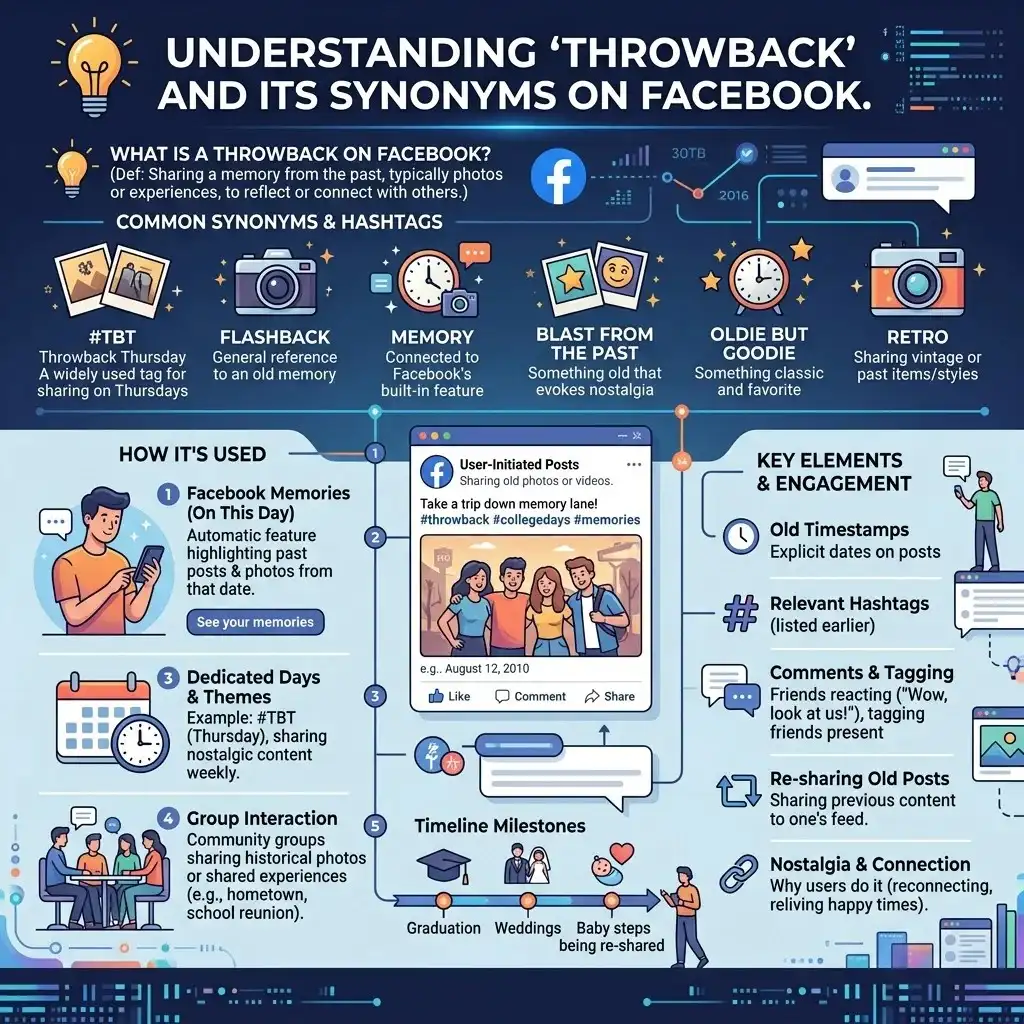
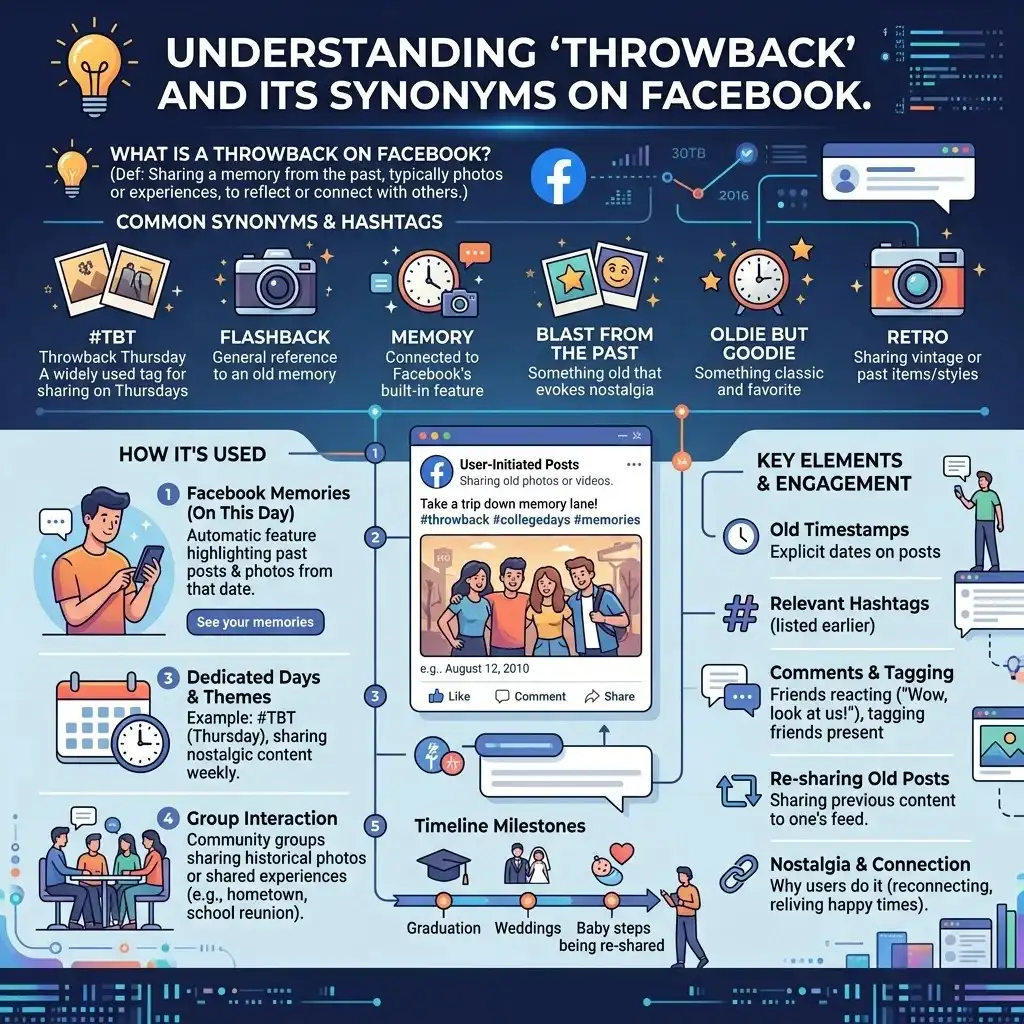
Every single day, people flood Facebook with throwbacks, old photos, and stories from years gone by. One post can open a tiny door to the past and invite hundreds of people inside. 📸
Last week, one woman shared a wedding photo from thirty years ago. Under the picture, she wrote:
“Throwback to the best day of my life!”
Immediately, her old friends filled the comments with memories and emotions.
- One friend wrote, “This brings back deep nostalgia!”
- Another replied, “What a wonderful flashback!”
- A third person commented, “Memory lane hits hard today.”
Although these words sound similar, each one carries its own flavor and feeling. Some describe emotions. Others describe memories, objects, or sudden thoughts.
People use throwback and its synonyms because they:
- connect the past with the present
- strengthen friendships online
- create emotional conversations
- spark laughter and storytelling
- help families relive beautiful moments
Today, learners notice these words everywhere on social media. They appear in captions, hashtags, comments, reels, and stories. Because of that, learners need to understand the tiny differences between them.
When someone masters throwback and its synonyms, they unlock an important part of modern online English. These words do not simply describe old memories. Instead, they reveal emotion, culture, humor, and human connection. Click here for more synonyms.
Throwback and Its Synonyms: Why Learners and Experts Need Them
Facebook reaches billions of users across the world. As a result, throwback vocabulary now plays a huge role in digital communication.
Why Learners Need These Words
English learners often struggle when they see hashtags like:
- #ThrowbackThursday
- #TBT
- #FlashbackFriday
- #MemoryLane
For example:
- A student in Brazil may see “#TBT” and feel confused.
- A teacher in Japan may want to explain English internet culture.
- A business owner in Kenya may need the perfect word to promote vintage fashion.
In each case, throwback vocabulary bridges cultural gaps.
These words help learners:
- understand social media conversations
- write natural captions
- express emotions clearly
- connect with native speakers
- understand modern internet culture
Why Experts Use Throwback Vocabulary
Content creators, marketers, teachers, and influencers rely heavily on emotional language. Throwback words create instant emotional engagement.
Marketers know something important:
People react strongly to memories.
For that reason, nostalgic posts often receive:
- more likes
- more comments
- more shares
- stronger emotional reactions
Teachers also use these words to demonstrate how technology shapes language. Society constantly moves forward, yet human hearts continue looking backward. Throwback vocabulary captures that beautiful contradiction.
How to Say These Words Out Loud (and Make Them Sound Natural)
Language becomes much more alive when you hear it in your head instead of just reading it on a page. So let’s give these words a voice.
🔹 Throwback
Say it slowly first:
THROW-back
Now split it like a rhythm beat:
- THROW → rhymes with go 🌊
- back → sounds like sack
In American English, it sounds like: /ˈθroʊˌbæk/
In British English, it softens slightly: /ˈθrəʊbak/
👉 Imagine you are tossing something into the past like a ball. That “throw” carries the word’s energy perfectly.
🔹 Flashback
Now feel the snap in this one:
FLASH-back ⚡
Break it down:
- FLASH → rhymes with dash or crash
- back → stays steady like before
American English: /ˈflæʃˌbæk/
British English: /ˈflæʃbak/
👉 This word feels like a sudden camera light going off in your mind, showing you a scene you did not expect.
🧠 Now that you can say them…
You are ready for the real magic: how these words behave in real life, in real sentences, and on real social media feeds.
🔍 Throwback vs. Other Words: What Sets Them Apart
These words look like cousins at a family gathering. They share roots, but each one tells a different kind of story.
🎞️ Throwback (the chosen memory)
A throwback always feels intentional.
You pick the memory and control the moment. You post it.
Example:
You scroll through old photos → you choose one → you post it today → you call it a throwback.
👉 It feels like opening a photo album on purpose and inviting others to join you.
⚡ Flashback (the surprise visitor)
A flashback does not wait for permission.
It jumps into your mind suddenly.
Example:
The smell of cookies fills the air → suddenly you see your grandmother’s kitchen → that is a flashback.
👉 It feels like your memory sneaks in through a side door you did not even notice.
💛 Nostalgia (the emotional glow)
Nostalgia is not an object or a picture.
It is a feeling that wraps around the heart.
Example:
You hear an old song → you feel warmth, sadness, and happiness mixed together → that is nostalgia.
👉 It does not show you the past. It makes you feel the past.
🧩 Memory (the general storage)
A memory is anything your mind keeps from the past.
It can be:
- happy 😊
- sad 😢
- neutral 😐
Example:
“I have a memory of that place.”
👉 It simply says: this moment exists in my mind.
🔎 Recollection (the careful search)
A recollection takes effort.
You dig into your mind to find it.
👉 It feels like searching a dusty shelf in a mental library.
🔔 Reminder (the trigger)
A reminder pushes your mind toward the past.
Example:
A photo, a smell, or a place reminds you of something old.
👉 It acts like a small bell ringing inside your thoughts.
📚 Retrospective (the big review)
A retrospective does not focus on one moment.
It looks at many past moments together.
👉 It feels like flipping through an entire chapter of your life, not just one page.
⏪ Rewind (the mental reset)
Rewind means going backward in time mentally.
👉 Like pressing a button that takes your thoughts to an earlier scene.
Online Use of Throwback and Its Synonyms
On Facebook and Instagram, people simplify everything:
- They use throwback for posts 📸
- They use flashback for sudden memories ⚡
- They use nostalgia for feelings 💛
Each word lives in its own space, but social media often blends them like colors on a palette.
And that is exactly what makes them so fascinating.
Flashback and Friends: More Words for Yesterday
- Flashback – The song gave me a flashback to my first dance.
- Memory – This photo holds a happy memory from summer camp.
- Reminder – The old toy is a sweet reminder of my fifth birthday.
- Recollection – Her smile brings a clear recollection of our first meeting.
- Nostalgia – The smell of rain fills me with deep nostalgia.
- Retrospective – The museum showed a retrospective of the artist’s early work.
- Rewind – Let us do a quick rewind to last year’s party.
- Look back – I like to look back at my old vacation photos.
- Yesteryear – The fashion from yesteryear looks fresh again today.
- Bygone – Those bygone days taught me lessons I still use.
Blast from the Past: Ten More Synonyms to Learn
- Old days – The old days were simple and full of laughter.
- Blast from the past – Seeing my old bike was a real blast from the past.
- Memory lane – Walking down memory lane makes me smile.
- Recall – I recall the day we built that sandcastle together.
- Reminiscence – Grandpa shared a reminiscence about his first car.
- Retro – Her retro dress turned heads at the school dance.
- Classic – That classic movie still makes me cry every time.
- Vintage – The vintage radio plays music from the forties.
- Old school – His old school methods still work better than apps.
- Antique – The antique mirror once hung in my mother’s room.
Golden Oldie and Company: Words That Sing of the Past
- Former times – In former times, people wrote letters by hand.
- Days gone by – The farm reminds me of days gone by.
- Past times – Past times shape the person you become.
- History – Our family history lives in these old photo albums.
- Heritage – The recipe is part of my cultural heritage.
- Legacy – The teacher left a legacy of kindness in every student.
- Tradition – Sunday dinner is a tradition we never skip.
- Custom – The custom of greeting neighbors started in my childhood.
- Oldie – That song is an oldie but still a goodie.
- Golden oldie – The golden oldie played on the radio all morning.
Back in the Day: Ten Phrases for Old Memories
- Back in the day – Back in the day, we played outside until dark.
- Long ago – Long ago, my father taught me how to fish.
- Early days – The early days of the club were full of hope.
- Childhood – My childhood home stands at the end of this road.
- Youth – In my youth, I dreamed of becoming a pilot.
- Good old days – The good old days were not perfect, but they were ours.
- Yesterday – Yesterday seems far away when I look at this picture.
- Time gone by – Time gone by leaves gifts we often miss.
- Former days – In former days, the store stayed open late.
- Past era – The past era of silent films holds strange beauty.
Old Times and Treasures: The Final Ten Synonyms
- Old times – Old times come alive when friends gather to talk.
- Remembrance – The bracelet is a remembrance of our summer trip.
- Keepsake – This shell is a keepsake from our beach vacation.
- Memento – The ticket stub serves as a memento of the concert.
- Relic – The relic from the old factory still sits in the town square.
- Artifact – The artifact tells a story about life long ago.
- Souvenir – The souvenir from Paris rests on my bookshelf.
- Token – The medal is a token of my father’s army service.
- Echo – The echo of that laughter still rings in my ears.
- Shadow – The shadow of the past sometimes falls on today.
Throwback vs. Other Words: What Makes Each One Different?
Many people treat these words like twins. However, each word lives in its own little neighborhood.
Throwback
A throwback describes something old that you intentionally share.
You choose:
- the photo
- the memory
- the moment
- the caption
Example:
“Throwback to our school trip!”
Flashback
A flashback arrives suddenly and unexpectedly.
A smell, sound, song, or picture suddenly pulls you into the past.
Example:
The smell of cookies gave her a flashback to her grandmother’s kitchen.
Nostalgia
Nostalgia describes a warm emotional longing for the past.
It lives inside the heart, not inside the photo.
Example:
Old cartoons fill many adults with nostalgia.
Memory
A memory includes any stored thought or image from the past.
Simple and broad, this word fits almost every situation.
Recollection
A recollection requires effort. You search your mind carefully before the memory appears.
Reminder
A reminder triggers thoughts about earlier times.
Retrospective
A retrospective looks back at many past events together, often in an organized way.
Rewind
Rewind means returning mentally or physically to an earlier point.
Famous Throwbacks in Movies, Books, and Real Life
People adore throwbacks because shared memories unite strangers instantly. 🎬📚
Many famous movies, books, and celebrities create powerful nostalgic reactions.
Popular Examples
- The Lion King reminds millions of people about childhood movie nights.
- Little Women brings readers back to family-centered traditions.
- Michael Jackson creates strong nostalgic feelings for music lovers around the globe.
- Friends acts like a weekly reunion for many fans.
Facebook pages also post images of:
- rotary phones
- cassette tapes
- floppy disks
- old classrooms
- vintage toys
These posts explode with engagement because people love shared memories. Celebrities post throwback photos from early career days, while ordinary people upload childhood pictures or school memories.
In every case, the past becomes a bridge to modern connection.
Why Throwback Words Confuse Even Native Speakers
Even native speakers mix these words up constantly.
The Biggest Source of Confusion
People often confuse:
- the memory itself
- the emotion connected to the memory
For example:
“Feeling nostalgic about this throwback photo.”
Technically:
- the photo = throwback
- the emotion = nostalgia
However, social media moves quickly. Most users focus on feelings instead of perfect definitions.
Common Mistakes
| Incorrect Use | Better Use |
|---|---|
| Flashback Friday for planned posts | Throwback Thursday |
| Nostalgia photo | Throwback photo |
| Random memory called flashback | Memory or recollection |
Because these words overlap emotionally, confusion spreads easily.
Throwback and Its Synonyms: Similarities and Differences
All these words share one important idea:
They pull attention toward the past.
However, each one travels there differently.
Shared Features
- They connect past and present.
- They trigger emotion.
- They encourage storytelling.
- They create social connection.
Key Differences
| Word | Main Focus |
|---|---|
| Throwback | Shared old moment |
| Flashback | Sudden memory |
| Nostalgia | Emotional longing |
| Memory | General remembrance |
| Retro | Old-fashioned style |
| Vintage | Valuable old object |
Think of them like travelers on the same road wearing different clothes. 🚂
Pick the Perfect Word for Every Facebook Post
Choosing the right word sharpens your message instantly.
Best Situations for Each Word
Flashback
Use for sudden memories.
Example:
“That song gave me a flashback to college.”
Nostalgia
Use for emotional longing.
Example:
“Rainy evenings always fill me with nostalgia.”
Retro
Use for fashion or design styles.
Example:
“Her retro kitchen looks amazing.”
Vintage
Use for authentic old objects.
Example:
“He collects vintage cameras.”
Blast from the Past
Use for funny or exciting surprises.
Example:
“This photo feels like a blast from the past!”
Back in the Day
Use when telling stories about earlier times.
Example:
“Back in the day, kids played outside until sunset.”
Metaphors and Comparisons: Making Throwback Words Come Alive
Creative comparisons help learners remember meanings more easily.
Powerful Images
- A throwback acts like a tiny time machine.
- Nostalgia wraps around the heart like an old blanket.
- A flashback strikes like lightning across the sky.
- Memory works like a bridge between yesterday and today.
- Vintage objects age like fine wine.
- A blast from the past feels like an unexpected knock from an old friend.
These images paint meaning directly into the reader’s imagination.
Positive and Negative Feelings Behind Throwback Words
Not every memory feels warm and comforting.
Different words carry different emotional tones.
Mostly Positive Words
Throwback
Usually cheerful and celebratory.
Example:
“Throwback to graduation day!”
Retro
Often stylish and trendy.
Vintage
Usually suggests quality and value.
Reminiscence
Feels warm and thoughtful.
Neutral Words
Memory
Can feel happy, sad, funny, or neutral depending on context.
Sometimes Negative Words
Flashback
Often appears in discussions about trauma or fear.
Example:
“The loud sound triggered a bad flashback.”
Nostalgia
Can become painful when someone misses the past too deeply.
Old Sayings That Match Throwback Moments
English contains many famous sayings about the past and memory.
Popular Proverbs and Expressions
“The past is a foreign country.”
People from earlier times lived differently.
“Hindsight is twenty-twenty.”
Looking backward makes things clearer.
“Time heals all wounds.”
Pain usually softens with time.
“The good old days were not always good.”
People often romanticize the past.
“Every cloud has a silver lining.”
Even difficult memories can teach valuable lessons.
These sayings enrich Facebook captions and help writers sound more natural, thoughtful, and expressive.
Final Thoughts
Throwback and its synonyms do far more than decorate social media posts. They create emotional bridges between generations, friends, families, and cultures.
Every throwback photo whispers a small message:
“Remember this moment with me.”
That simple idea explains why humans continue looking backward even while racing toward the future
Throwback Words: How They Help Our Communities
These words build bridges between generations. A grandmother uses a throwback photo to tell her story. A teenager learns family history through those images. Teachers use these words to help students compare past and present. Therapists use memory talk to heal old wounds.
Museums use retrospective language to honor artists. Communities use heritage and tradition to keep culture alive. When you share a throwback on Facebook, you invite others to remember with you. This act creates empathy. It reminds people that they are not alone in their journey.
New language learners gain confidence when they use these words correctly. They join conversations that matter. Experts use them to shape brands and messages that touch hearts. The world needs words that honor where we came from. Throwback and its synonyms do exactly that.
What People Type When They Search for Throwback Words
- What does throwback mean on Facebook
- Throwback Thursday vs Flashback Friday difference
- Synonyms for throwback in English
- How to use nostalgia in a sentence
- Throwback meaning for beginners
- Difference between retro and vintage explained simply
- Words like throwback for social media posts
- Nostalgia definition with examples
- How to write a throwback caption on Facebook
- Throwback synonyms list for English learners
- Memory vs recollection simple explanation
- Why do people post old photos on Facebook
- Best words to describe old times
- Throwback quotes for Instagram and Facebook
- Easy English words about the past
Final Thoughts on Throwback and Its Synonyms
Throwback and its synonyms give voice to the past. They let you hold yesterday in your hands today. Each word carries its own weight and its own warmth. Learn them one by one. Use them in your posts. Watch how people respond. The right word at the right moment turns a simple photo into a shared experience. Keep these words close. They will serve you well on Facebook and in life.
Five Big Questions About Throwback and Its Synonyms
Question 1: Can I use flashback and throwback the same way on Facebook?
No, you cannot. A throwback is a post you plan to share. A flashback is a sudden memory that finds you. Use throwback for Thursday posts. Use flashback when a surprise triggers your mind.
Question 2: Is nostalgia the same as a throwback?
No, it is not the same. Nostalgia is a feeling. A throwback is a thing or post. The throwback photo causes the nostalgia. They work together, but they are not twins.
Question 3: Why do people write #TBT instead of “throwback”?
TBT means “Throwback Thursday”. It saves space and joins a global trend. Millions of people search this tag every week. It helps your post reach more eyes.Question 4: Can a throwback be sad?
Yes, it can. Most throwbacks are happy, but some honor people who passed away. Some mark hard times that shaped you. The word itself does not judge the feeling.
Question 5: Which synonym should new learners learn first?
Start with memory. It is the most common and flexible word. Then learn throwback for social media. Then add nostalgia and flashback for deeper expression.
Conclusion
Throwback and its synonyms open bright doors to the past on Facebook. They help beginners speak like native speakers. They help experts reach wider crowds with ease. Each word holds a special place in the big puzzle of English. Flashback surprises you when you least expect it. Nostalgia warms your heart on cold days. Memory stays with you like a faithful friend. Throwback invites you to share a piece of your story. When you master these words, you master a huge part of online conversation. Use them with care. Use them with joy. The past deserves good words, and you now hold the right ones in your hands. Start today. Post a throwback. Write a memory. Join the global talk about yesterday. For a video, click here.

The author is a Ph.D scholar and writes on multiple topics of interests related to science, technology, society, history etc. The purpose behind all this stuff is to raise public awareness in different domains.